
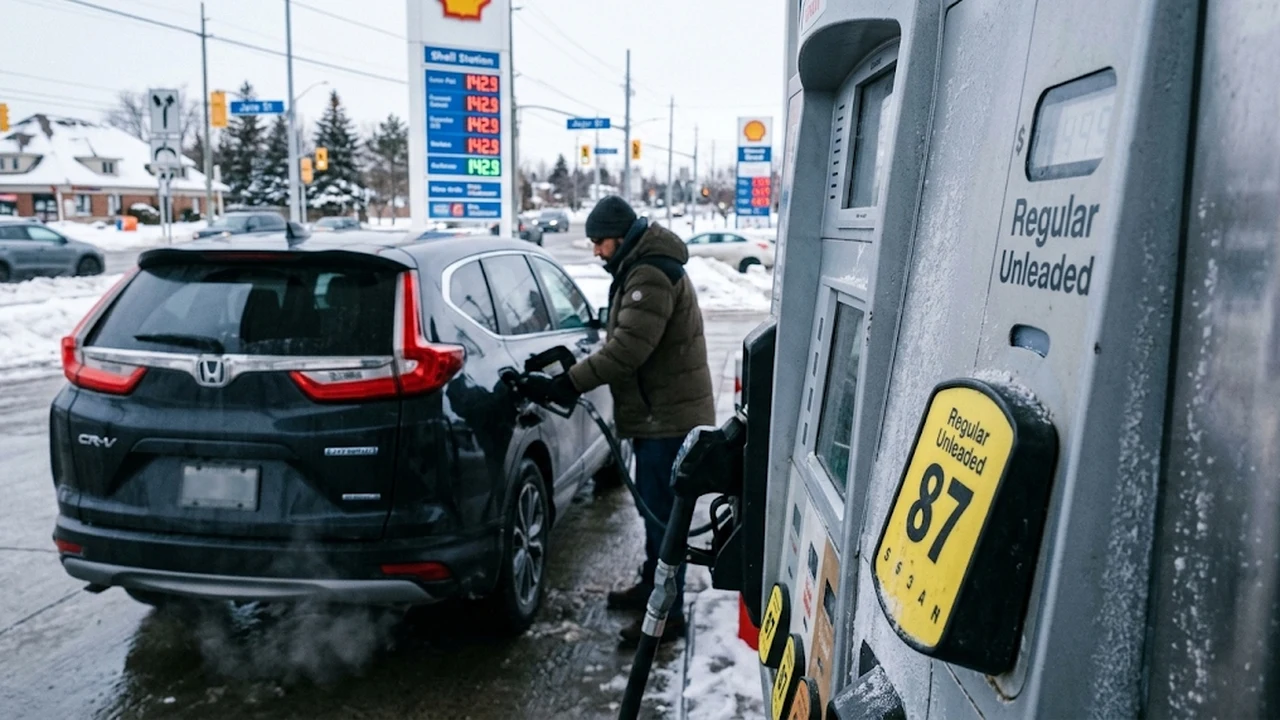
Photo: Honda Canada. The CR-V Hybrid still uses less fuel than the gas model all year — even through a Vaughan January.
If your CR-V Hybrid uses more fuel in winter, several factors can contribute. Natural Resources Canada notes that cold starts, idling, winter tires and cold conditions can reduce fuel efficiency. The amount varies by driver and trip; a single tank cannot identify the share caused by any one factor.
What the CR-V Hybrid is actually rated to do
Honda Canada rates the 2026 Honda CR-V Hybrid (with Real Time AWD) at 6.0 L/100 km in the city, 6.9 L/100 km on the highway, and 6.4 L/100 km combined. Yes — city is better than highway on a hybrid, because stop-and-go driving is where the electric motor and regenerative braking do their best work.
For comparison, the gas-only CR-V with the 1.5-litre turbo and AWD is rated around 8.4 L/100 km combined. With a fuel tank of roughly 53 litres, the hybrid's combined rating works out to something like 800-plus kilometres on a tank in good conditions — a big part of why people love it.
So why does winter change the numbers?
None of these are faults. They're physics, and they affect every vehicle on the road in a GTA winter:
- Cold engine, cold fluids. Engine oil and driveline fluids thicken in freezing weather, producing higher mechanical drag until the car reaches operating temperature.
- The gas engine runs to generate cabin heat. A hybrid maximizes efficiency by shutting the engine down whenever possible. In an Ontario winter, the engine must stay running frequently just to supply heat to the heater core and defrost the windshield, sharply cutting your electric-only driving time.
- Short trips keep the engine cold. Quick 3–5 km trips across Vaughan are the hardest on winter mileage: the powertrain spends the entire drive in its high-fuel warm-up cycle.
- Sluggish battery chemistry and reduced regen. Lithium-ion cells resist rapid charging when freezing cold. Regenerative braking is automatically dialed back until the battery pack warms up, capturing less stopping energy.
- Tires and denser winter air. Ambient cold drops tire pressure by roughly 1 psi for every 5°C drop, increasing rolling resistance alongside soft winter tire compounds. Freezing air is also physically denser, creating more aerodynamic drag at highway speeds.
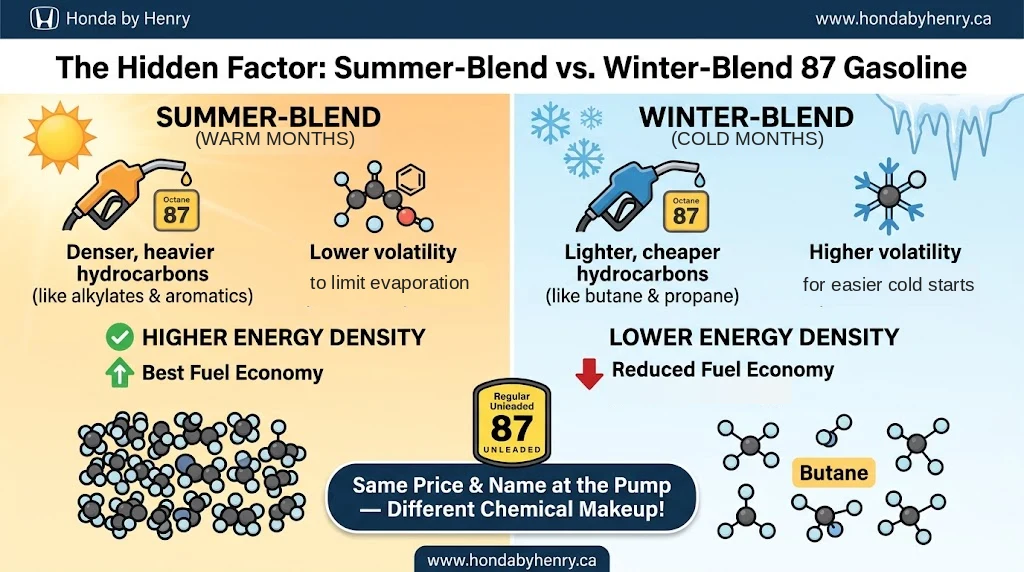
- Seasonal fuel changes. As explained below, the 87 regular gasoline dispensed across Ontario in winter physically contains less energy per litre than summer gas.
The hidden factor: Summer-blend vs. winter-blend 87 gasoline
When you pull up to the pump at Jane and Major Mackenzie in January, the yellow button still says 87 Regular Unleaded — identical to July. Most drivers assume the fuel is the same. It isn't. The chemical composition changes twice a year across Canada, and it plays a major, underreported role in your CR-V Hybrid's winter numbers.
Why winter driving can change fuel economy
Natural Resources Canada explains that cold weather can reduce fuel efficiency through factors such as cold starts, extended idling, winter tires and colder operating conditions. The effect depends on the vehicle and how it is driven. NRCan winter fuel-efficiency guidance
Seasonal gasoline specifications can change for cold-weather operation, but the public sources checked for this article do not quantify a fixed energy penalty for one Ontario fill-up or a set number of kilometres lost per tank. This article cannot separate the effect of fuel formulation from temperature, short trips, cabin heat, tires, traffic or driving style.
For a Canadian reference point, Honda rates the 2026 AWD CR-V Hybrid at 6.0 L/100 km city, 6.9 highway and 6.4 combined. Those standardized ratings are useful for comparisons; they do not predict one driver's winter result. See Honda Canada's CR-V specifications.
 AI creative image
What we cannot quantify from a single tank
There is no verified Ontario-wide pump changeover date in the cited material, and no source here supports a precise butane percentage, RVP range, fuel-energy difference or fixed per-tank range loss for the 2026 CR-V Hybrid. Treat the exact contribution of winter gasoline to an individual fuel-economy change as unknown.
Ways to reduce winter fuel use
These habits can reduce avoidable fuel use. The result varies with the trip and conditions:
- Skip the long idle warm-up. Idling burns fuel and warms the car slowly — the engine warms fastest while driving. Pull away gently after about 30 seconds.
- Combine your errands. One longer trip with a warm engine beats five cold starts. This is the single biggest winter fuel saver for short-trip drivers.
- Check your tire pressure monthly in winter. Cold air lowers it; topping up to the door-jamb spec cuts rolling resistance.
- Run proper winter tires. They're a safety must in the GTA, and correctly inflated winter tires keep the fuel penalty small.
- Park inside if you can. A garage means a warmer start, so the engine reaches its efficient temperature sooner.
- Use the heated seats and steering wheel. They warm you directly for very little energy, so you can ease off blasting the cabin heater.
A quick myth to clear up
Some owners conclude the winter dip means the hybrid system is failing or that "hybrids don't work in Canada." Neither is true. The dip is temporary and seasonal — as spring returns and summer-blend fuel comes back, the numbers climb right back toward the rating. If your fuel economy is wildly off all year round, that's worth a conversation with your service advisor; a normal winter dip is not.
Bottom line: a thirstier CR-V Hybrid in January isn't a problem with your car — it's winter doing what winter does. Even with the seasonal dip, the hybrid still uses noticeably less fuel than the gas model, and a few smart habits keep your range where you expect it.
Shopping a CR-V Hybrid, or already own one and want a straight answer about your winter numbers? Text or call — I'll talk you through it in plain English, no scripted pitch.
Honda Canada rates the 2026 CR-V Hybrid AWD at 6.0 city / 6.9 highway / 6.4 combined L/100 km. Ratings are not a promise of winter consumption; real results vary with conditions and use.
Frequently asked, Vaughan edition
Why does my Honda CR-V Hybrid use more fuel in winter?
Cold starts, idling, cabin heat, winter tires, temperature, trip length and driving conditions can affect fuel use. NRCan describes several winter-efficiency factors, but their exact contribution to one vehicle or one tank is not known from the public data cited here.
Does a winter fuel-economy drop mean my hybrid system is failing?
Not by itself. Cold weather and short trips can increase fuel use. If you see a sudden change, warning light or abnormal behaviour, check the owner's manual and have the vehicle inspected by a qualified technician.
What's the best way to improve CR-V Hybrid fuel economy in a Vaughan winter?
Keep tires at the pressure on the driver-door placard, limit extended idling, remove unnecessary cargo, combine short trips when practical and drive smoothly. Results depend on conditions; no habit can promise a specific range.
Does the CR-V Hybrid still beat the gas CR-V on fuel in winter?
Honda Canada's published combined ratings are 6.4 L/100 km for the 2026 AWD CR-V Hybrid and 8.4 for the comparable AWD gas CR-V. Those are standardized ratings, not a guarantee for every winter trip; actual consumption varies.
What is the 2026 Honda CR-V Hybrid AWD rated for in Canada?
Honda Canada lists 6.0 L/100 km city, 6.9 highway and 6.4 combined for the 2026 AWD CR-V Hybrid. Real-world and winter consumption can differ from standardized ratings.
Is winter-blend 87 gasoline different from summer gas?
Seasonal gasoline specifications can change to support cold-weather operation, but the sources cited here do not establish a fixed 1.5%-3% energy difference, a precise Ontario changeover date or a set kilometre loss per tank. The exact effect on an individual CR-V Hybrid is not quantified.
Questions about your CR-V Hybrid's winter numbers?
Henry Chen at Maple Honda will walk you through it in plain English — whether you're shopping a hybrid or already own one.