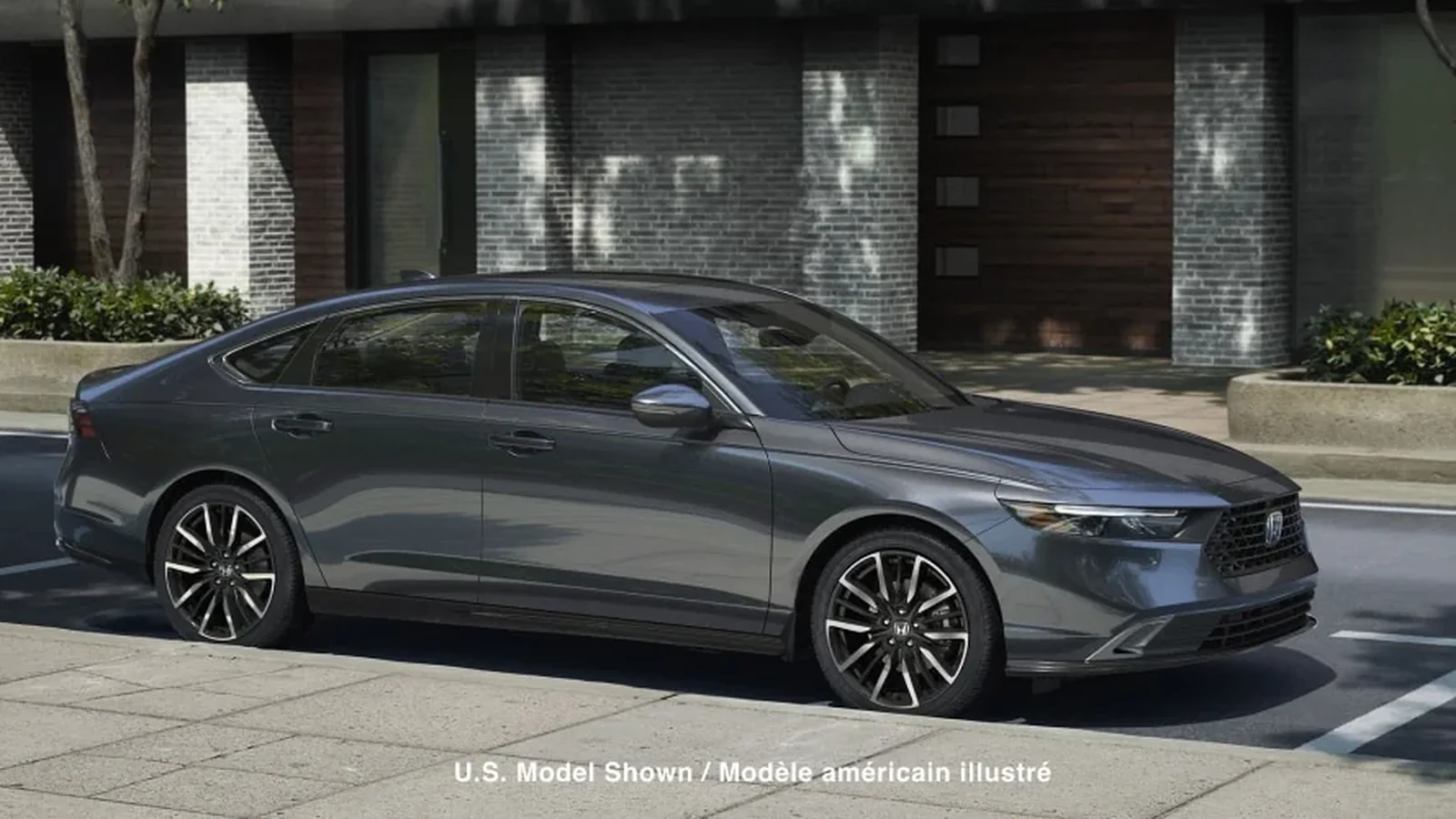
Right now, a Highway 400 daily commute out of Vaughan means construction on top of the usual grind — Huntington Road is still closed at Trade Valley for the sinkhole repair, and there's ongoing work at the Rutherford Road rail bridge. Neither closure touches the 400 itself, but both push extra local traffic onto Jane Street and Weston Road at the exact hours you're trying to merge onto the highway. That's the environment I actually shop cars for, not a clean test-track loop.
The hybrid math, done properly
Honda's current Civic Hybrid and Accord Hybrid share the same two-motor hybrid system: the car drives on electric power at low speed and in traffic, the gas engine charges the battery when it makes sense, and a single lock-up clutch connects the engine directly to the wheels once you're settled at steady highway speed. It's not a dual-clutch transmission and there's nothing to shift-shock — it's the reason the system performs so well specifically in the stop-start pattern of a 400 commute.
On paper: Civic Hybrid rates 4.9 L/100 km combined against 6.9 L/100 km for the gas Civic. Accord Hybrid rates 5.3 L/100 km against 7.3 L/100 km for the gas Accord. Both hybrids also carry the Atkinson-cycle engine's roughly 41% thermal efficiency versus about 20% for a typical gas-only engine — the underlying reason the fuel-economy gap holds up in real commuting, not just on a lab cycle.
Civic Hybrid or Accord Hybrid — which one actually fits your drive
This is where I split people up, and it isn't about which car is "better." If most of your Highway 400 daily commute is inside Vaughan — short hops between Weston Road, Jane Street, and Highway 7 — the Civic Hybrid's smaller footprint and lower price point make it the more sensible daily driver. If your commute is a longer run north toward Barrie or south into the city on the 400 proper, the Accord Hybrid's larger cabin and 16.7 cu ft trunk (compared with a Camry's 15.1 cu ft, for anyone cross-shopping) make an hour-plus of highway driving noticeably less tiring. Neither one is the "wrong" answer — it's a question of how many of your commute minutes are spent at highway speed versus creeping through a merge.
Brake wear is the part nobody asks about
A 400 commute means being on and off the brake pedal constantly, and that's exactly where Honda's hybrid models are built differently. The hybrid CR-V, Civic, and Accord use dual-piston brake calipers, which spread clamping force more evenly across the pad than a single-piston caliper, wear more evenly as a result, and dissipate heat better under repeated light braking. Over a few years of daily stop-and-go, that shows up as more even pad wear and fewer surprise trips in for brake service — not a dramatic difference on any single drive, but a real one over a five-year ownership window on this specific kind of commute.
What Honda Sensing is actually doing in stop-and-go
Adaptive Cruise Control is the feature that earns its keep on the 400: it sets both a target speed and a following gap, and it holds that gap automatically as traffic compresses and releases — which is the entire pattern of a merge-heavy commute. Blind-Spot Monitoring is deliberately tuned to activate only above 32 km/h, so it's meaningful at highway speed instead of chattering every few seconds in slow city traffic. Low-Speed Braking Control covers the 2 to 10 km/h range specifically — the creep-and-stop zone right at a 400 on-ramp, which is a different problem than either full highway speed or a complete stop.
Henry's take: the hybrid premium on a Civic or Accord pays for itself fastest for drivers logging real daily kilometres on the 400 — not the occasional weekend errand. If your commute is short and mostly local, the gas version and the money saved up front is often the smarter call.
Why the Alliston build story matters here specifically
Honda's Alliston, Ontario plant has built the Civic and CR-V since 1986, employs over 4,200 people, and runs as a zero-waste-to-landfill facility. For a commuter car, that build location matters less for the drive itself and more for what happens after — shorter supply lines for the parts a daily 400 commute wears out fastest (brakes, filters, tires), and a service network sized around cars built close to home rather than shipped across an ocean.
If you're weighing a used Honda instead of new for this exact commute, a Honda Certified pre-owned Civic or Accord Hybrid carries the same two-motor system and dual-piston brakes at a lower entry price — worth cross-shopping before you commit to new. And if your Highway 400 daily commute is about to change shape entirely — kids moving out, downsizing the household — I've written separately about right-sizing your next car as a Vaughan empty nester.
Frequently asked, Vaughan edition
Is the Accord Hybrid or Civic Hybrid better for a long Highway 400 daily commute Honda buyers actually keep?
If your commute is mostly steady highway miles with a long stretch north of Vaughan, the Accord Hybrid's larger cabin and 16.7 cu ft trunk make the daily grind easier to live with. If your drive is shorter and more stop-and-go inside Vaughan itself, the Civic Hybrid's 4.9 L/100 km rating and tighter footprint are the more practical pick. Both share the same two-motor hybrid system, so the fuel-economy gap between them is smaller than the price gap.
Do hybrid brakes actually hold up better in daily 400 stop-and-go?
Honda's hybrid models use dual-piston brake calipers, which spread clamping force more evenly across the pad than a single-piston design, wear more evenly, and dissipate heat better. That matters on a commute where you're on and off the brake every few seconds rather than a handful of times on a long open drive.
Does Honda Sensing's Adaptive Cruise Control really help in 400 traffic?
Yes — Adaptive Cruise Control sets both a target speed and a following gap, and it holds that gap automatically as traffic compresses and releases, which is the exact pattern of a 400 commute. Blind-Spot Monitoring is tuned to activate above 32 km/h so it stays useful at highway speed instead of chattering in slow city traffic, and Low-Speed Braking Control covers the 2 to 10 km/h creep-and-stop range specifically.
How much does the Alliston build story matter for a 400 commuter car?
It matters for parts and service more than for the drive itself. Honda's Alliston, Ontario plant has built Civic and CR-V since 1986, which means shorter supply lines for the parts that wear fastest on a commuter car — brakes, filters, tires — and a service network built around cars that were assembled close to home.
Want help with Highway 400 daily commute Honda picks from a real human?
Henry Chen at Maple Honda will walk you through the numbers in plain English — no pressure, no scripted pitch. Book a test drive online, or text a photo of any written quote to (647) 523-6878 for a free 15-minute review.
Ask Henry a question
Not ready to book anything? Just ask. Henry Chen answers every message himself — usually within a couple of hours during business hours. No call list, no pressure, and no obligation to buy anything.