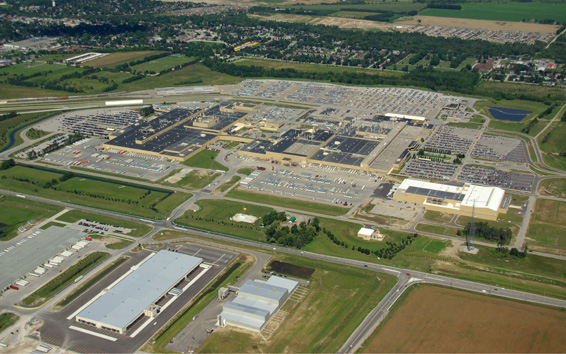
Image: Honda of Canada Mfg. The Alliston campus — 4 million square feet, two assembly plants, the Civic and CR-V. Brampton Assembly is the comparable Detroit Three plant that may end up as the asset BYD is reportedly eyeing.
Canada’s Industry Minister Mélanie Joly returned from Shanghai and Beijing in June 2026 with an explicit offer to BYD, Geely, Chery, and Shanghai Launch Automotive: build an EV assembly plant on Canadian soil, structured as a joint venture with majority Canadian ownership, and the 49,000-vehicle annual cap on Chinese-made EVs effectively disappears. Joly’s framing to BNN Bloomberg: “build where you sell.” The condition is the spine of every future Chinese-brand allocation in Canada — and the part of the deal Beijing, the Chinese OEMs, and Unifor are each trying to renegotiate. BNN Bloomberg, June 2026 · Canada Gazette, SOR/2026-32
1The pitch, in one sentence
Canada’s Industry Minister Mélanie Joly has told BYD, Geely, Chery and Shanghai Launch Automotive that they can sell past the country’s 49,000-vehicle annual cap on Chinese-made EVs — but only if they put an assembly plant on Canadian soil, structured as a joint venture with majority Canadian ownership, using Canadian suppliers, respecting Canadian labour law, and signing off on a hard data-security regime that keeps driver telemetry out of Beijing’s reach.
That sentence is doing a lot of work. Behind it sit a 100% tariff that used to be in place, a quota carve-out tied to a $35,000 price ceiling, an exploding geopolitical fault line between Ottawa and Washington, a labour union on the verge of open revolt, and — most consequentially — a Chinese industry that has so far politely declined the architecture Canada has in mind.
2How we got here: a 14-month U-turn
The timeline matters because it tells you what kind of policy this actually is — and what kind of pressure is shaping it.
- October 2024. The Trudeau government, moving in lockstep with Washington, slaps a 100% surtax on Chinese-made EVs. Combined with Canada’s existing 6.1% MFN rate, the effective tariff briefly hit 106.1% — a near-absolute barrier. At the time, Ottawa justified it on the grounds of unfair subsidies and “non-market” overcapacity.
- January 2026. Mark Carney’s new government, less than a year later, swaps that 100% wall for a 49,000-vehicle annual quota at the ordinary 6.1% MFN rate. In return, China lifts retaliatory tariffs on Canadian canola and seafood. The Canada Gazette formalises the regime in SOR/2026-32 (Order Amending the Import Control List, 11 March 2026). The new system takes effect that same month.
- March–May 2026. The first 24,500 import permits are issued. Lotus (Geely-owned) is among the first brands to ship from Chinese ports to Canada. Chery and BYD enter in waves. Tesla, notably, is reported to have quietly shifted some Model 3 supply for Canada to its Shanghai gigafactory — the new tariff math makes a Shanghai-sourced Model 3 economically rational again.
- June 2026. Joly travels to Shanghai and Beijing. After sitting down with executives from BYD, Geely, Chery and Shanghai Launch Automotive Technology (an R&D outfit, not a brand you or I have ever bought a car from), she emerges with the now-famous “one condition” framing.
In other words: a country that, 20 months ago, all but banned the product, is now actively courting the manufacturers of it. The political about-face is sharper than it looks — and it explains both the urgency in Joly’s tone and the suspicion from every direction.
3The quota itself: more layered than the headline
The “49,000 cars a year” figure is technically accurate and politically misleading. The regime actually contains four moving parts:
- The headline cap. 49,000 Chinese-made EVs per year, beginning 1 March 2026, running through 28 February 2027 for the first tranche. After that the volume rises 6.5% per year, putting the ceiling around 70,000 by 2030–31. Vehicles inside the cap pay the 6.1% MFN rate. Anything above pays the 100% surtax — which, on a $40,000 EV, is a $40,000 surcharge. So “past the quota” is, in practice, only ever a phrase used at the negotiating table.
- The price-reservation rule. A growing share of the quota is reserved for EVs with a FOB import price of $35,000 or less (about C$48,000). It starts at 10% in year two and climbs to 50% by year five. This is a deliberate market-shaping lever: Canada wants affordable commuter EVs, not premium Chinese flagships.
- The permit allocation. The first 24,500 permits were issued from 1 March. Distribution is allocated by Global Affairs Canada, with explicit weight toward price-sensitive models. Tesla and Polestar — both of which have Canadian service footprints and (in Tesla’s case) a captive charging network — are positioned to consume a disproportionate share of the early permits.
- The off-ramp Joly just opened. Here’s the new piece: vehicles assembled in Canada under the JV conditions can effectively sidestep the cap. The quota was originally an import ceiling. Joly is now offering to convert it into a domestic-production floor — “build where you sell,” as she put it to BNN Bloomberg.
For a Chinese OEM, the arithmetic is brutal-but-tempting: stay inside the 49,000-unit wall, watch a competitor claim the 50,001st vehicle, or commit hundreds of millions (and political capital) to a Canadian plant that may not pencil out.
4The four conditions, decoded
Joly has now repeated the same four conditions across multiple press appearances, parliamentary committee testimony, and her China trip. They are the spine of the offer. They are also the spine of the fight.
Condition 1 — Joint venture, majority Canadian-owned
On its face, this is the most restrictive element and the one Chinese OEMs are most reluctant to accept. A majority-Canadian-owned JV means the Chinese partner cannot fully control the IP, the supply chain, the export strategy, or the cash. In an industry where BYD, for one, has built its entire commercial moat on vertical integration — from lithium cells to body stampings to in-house silicon — handing operational control to a partner is structurally alien.
Condition 2 — Canadian suppliers, Canadian labour codes
This isn’t window dressing. The condition forces the Chinese OEMs to source meaningfully from the Canadian parts base (Magna, Linamar, Martinrea, et al.) and to operate under provincial labour standards. In practice that means unionised or union-compatible shop floors, the kind Brampton and Oshawa assembly workers understand. It also binds the Chinese partner to overtime, health-and-safety, and collective-bargaining norms that don’t exist in their domestic operations. This is the condition most likely to delay any deal, because it forces a Chinese OEM to negotiate a Canadian workforce contract before they’ve even broken ground.
Condition 3 — Data security
This is the one that scares national-security hawks in Washington. Joly has framed it explicitly: vehicle-collected data — including everything a driver streams through phone pairing, telemetry, location, infotainment logs — must not transit to “the Chinese government.” The technical implementation here is non-trivial. Modern Chinese EVs are essentially connected devices with wheels: OTA updates, remote diagnostics, app-driven features. Carving out a “Canadian data enclave” requires either a parallel software stack or contractual restrictions backed by audit rights. It is doable. It is also unprecedented at scale in the Chinese OEM playbook.
Condition 4 — Strategic alignment with Canada’s industrial goals
This is the softest in language and the hardest in practice. Joly wants vehicles “made in Canada for the world” — export-oriented, not just domestic-market-aimed. The implicit bet is that a Canadian-assembled Chinese EV can be exported tariff-free or at preferential rates into markets where a fully Chinese-built car would face barriers (the EU’s CBAM-style EV duties, US Section 301, UK/EU anti-subsidy investigations). Whether that bet actually holds depends on rules-of-origin — and is precisely the question Canada, the US, and Mexico are about to fight over in the CUSMA six-year review in mid-2026.
5BYD says no. That’s the news.
Most coverage has stopped at “Joly met with four Chinese automakers.” What hasn’t penetrated is what one of them said back.
Stella Li, BYD’s Executive Vice President and the public face of the company’s international expansion, was asked directly about the JV condition. Her response, reported by Bloomberg and confirmed by multiple Canadian outlets:
BYD is not refusing Canada. It is studying a plant. But it is refusing the structure Ottawa has offered. BYD’s preferred model — consistent with its Hungary, Brazil, Thailand, and Turkey plans — is 100% ownership and operation. Vertical integration, full IP retention, no minority partner with veto rights.
In the same news cycle, Li told Bloomberg BYD was open to acquiring an existing automaker outright. That line matters more than it sounds: it positions BYD not as a greenfield investor but as a potential acquirer of a struggling Canadian asset — and there is no shortage of those. Brampton Assembly, the Detroit Three’s crown jewel in Canada, has been operating well below capacity. Unifor has warned repeatedly that the plant’s long-term future is in question.
The strategic implication: BYD is essentially saying to Ottawa, “If you want us in Canada, give us the same deal you gave Volkswagen in 1984.” But Volkswagen in 1984 came in under a regime that didn’t yet exist; BYD in 2026 is being asked to come in under a regime designed specifically to constrain it.
Joly has signalled that there is “no flexibility” on the JV structure. But she has also said “there can be positive conversations leading potentially to decisions in future months” — diplomat-speak for the door is not closed, but the price of opening it just went up.
6The losers aren’t saying what you’d expect
Here’s where the story gets genuinely strange.
Mitsubishi Canada — a brand that, on paper, should hate this deal — has praised the Chinese product. President and CEO Kenichi Kawaji told reporters:
Mitsubishi’s strategy is now openly to not try to outbuild BYD in the affordable-EV segment, and instead to lean harder into hybrids where it has a real cost structure and a long warranty book. It’s a concession wrapped in a compliment.
Honda Canada took the opposite line. President Dave Jamieson said policies letting Chinese EVs in “are actively making Canada less competitive at exactly the moment we need to be strengthening our position,” and warned that “Canadian auto makers face rising competition from low-cost, state-subsidized, non-market-oriented producers.” Note the language — almost identical to the talking points the UAW has used in Washington. Jamieson is essentially speaking on behalf of an integrated North American industry, not just Honda’s Canadian dealers.
Joly’s reply to Honda was unusually sharp: “I reject that premise. We’re offering the best technology for Canadians while protecting 500,000 workers. We’re not putting any businesses in jeopardy.”
Unifor — the union that represents nearly all of Canada’s autoworkers, and the single most consequential domestic political actor in this file — has called the deal “a self-inflicted wound to an already injured Canadian auto industry.” National President Lana Payne has warned that “more than one-third” of Unifor members at the Detroit Three’s Canadian plants are currently on layoff, several facilities are running partial shifts, and the Chinese quota “provides a foothold to cheap Chinese EVs” while “putting Canadian auto jobs at risk.”
Payne’s most cutting line: Canada has “surrendered the leverage” of opening its market to China, making “finding a resolution to U.S. auto tariffs just got more difficult.” That’s a structural critique — that Canada spent its strongest trade-negotiation card (market access) on canola, not on the auto file.
The union’s preferred outcome is the one nobody in Ottawa wants to say out loud: don’t do the deal. Or, failing that, condition any expansion on binding job-creation commitments at the Detroit Three’s existing Canadian plants.
7The American shadow
It is impossible to read this story as a purely Canada-China story. Three things are happening in parallel in Washington.
First, US Transportation Secretary Sean Duffy has publicly said Canada would “regret” the Chinese EV deal — diplomatic language for we’re watching. The CFR has flagged the Canada-Mexico-China EV triangle as a major friction point ahead of USMCA renegotiation.
Second, President Trump himself softened on Chinese EVs in early 2026, telling a Detroit audience that Chinese automakers would be welcome in the US if they “build factories in the U.S. and hire American workers.” The line is rhetorically identical to Joly’s “build where you sell.” This is not a coincidence. It is, however, not yet a policy: the 100% Section 301 tariff on Chinese EVs remains in force, and the United Auto Workers is pushing to keep it.
Third — and this is the structural point — Canada is openly using the threat of expanded Chinese access as leverage in the CUSMA review. The message to Washington is: keep our integrated auto industry whole, and we’ll manage the China exposure ourselves. Force a harder break, and we have alternatives. Whether that bluff holds depends on whether anyone actually builds a Canadian plant.
Mark Carney, reportedly, made exactly that pitch to Trump directly — a hot mic at the G7 Summit caught the two leaders in conversation, with Carney heard framing the China EV deal as a concession Canada was making to give Washington political room on auto tariffs. If that leak is real, it explains a policy that otherwise looks incoherent: it was never primarily about cars. It was about CUSMA.
8The numbers nobody wants to show
A few benchmarks to size the stakes:
- 49,000 vehicles is roughly 3% of annual Canadian new-vehicle sales. That’s the size of the immediate Chinese share.
- 70,000 by 2030–31 would put the cap-controlled Chinese share at roughly 4–5% — modest in absolute terms, but concentrated in the affordable-EV segment where it hits hardest.
- A $35,000 FOB import price, after transport, dealer margin, taxes and the 6.1% tariff, lands at roughly C$48,000–50,000 on the lot. That’s the price band currently dominated by the Chevrolet Equinox EV, Hyundai Kona Electric, Kia Niro EV, and the base Tesla Model 3 — every one of which is, by global standards, a high-volume, high-employment product.
- Magna International, headquartered in Aurora, Ontario, is Canada’s largest auto-parts employer. It has already been in early discussions with Chinese OEMs. A JV that routes through Magna is a very different deal from one that bypasses them.
- The Canadian auto industry directly employs roughly 125,000 assembly workers and 400,000 parts workers. The “500,000 workers” figure Joly used is the total including dealers and aftermarket.
Put differently: the policy is asking 500,000 Canadian workers to absorb a managed ~3% import shock in exchange for a speculative bet on Chinese FDI that BYD has already said it doesn’t love.
9What to watch in the next 90 days
Five indicators will tell you whether the JV-conditional regime is real or theatre:
- A signed BYD-Geely-Chery MOU with a named Canadian partner. Without this, the “willing to explore” language stays vaporous. Magna and Linamar are the obvious names.
- A federal-provincial agreement on plant location. Ontario is the default. Quebec and British Columbia have made noises. The chosen province will signal whether this is a national industrial strategy or an Ontario auto vote-bank play.
- The CUSMA joint review (June 2026) outcome. If the USMCA auto rules of origin tighten, the Canadian JV thesis gets harder — a Canadian-assembled Chinese EV may not qualify for the preferential rate into the US market. If they loosen, the thesis gets easier.
- Unifor’s next bargaining round with the Detroit Three. Lana Payne has tied this file to the September 2026 negotiations. If Unifor extracts plant-specific EV commitments at Brampton or Oakville in exchange for not opposing the China deal, Joly wins politically. If she doesn’t, Unifor will make the JV condition the wedge issue of the next federal election.
- The price-reservation mechanism in practice. Year-two data on whether 10% of the quota is actually filled with sub-$35,000 EVs will tell you whether the policy is genuinely an affordability play or just a managed-trade fig leaf.
My prediction · Bold, 12 months: BYD walks on the JV structure. Chery signs a Magna JV for a southern Ontario plant by mid-2028. Geely follows a similar pattern. The visible “Canadian-assembled Chinese EV” on a dealership lot in 2029 is more likely to wear a Chery badge than a BYD one — and BYD’s Canadian footprint, if it materialises at all, comes through an acquisition of a distressed Detroit Three asset in the same window. The four-condition architecture is the framework Ottawa will live with for the next decade, not a transitional bargaining position.
10The honest read
The “one condition” framing is good politics — it makes a complex industrial policy sound like a simple bargain: “we’ll let you in, you build here.” But the reality is more like six nested bargains — with Chinese OEMs that don’t want to share equity, with Canadian unions that don’t want to share factories, with a US administration that doesn’t want Canada to share the North American auto perimeter, with provinces competing for the plant, with a parts industry that wants in, and with consumers who want cheaper EVs now, not in 2029.
The most likely outcome, on current evidence, is partial success: a single Chinese OEM — probably Chery, possibly Geely, almost certainly not BYD — signs a JV with Magna or Linamar, builds a 50,000-unit-a-year plant in southern Ontario by 2028–29, and uses it as a North American export hub. BYD holds out for 100% ownership, watches for two years, and either buys a distressed Detroit Three asset in 2028–29 or walks.
Canada, in that scenario, doesn’t get the 100,000+ assembly jobs the most aggressive estimates float. It gets maybe 3,000–5,000 direct jobs, plus supplier multiplier, plus a strategic foothold in the global EV value chain. It also gets a permanent irritant in its relationship with Washington, an unhappy labour movement, and a Chinese OEM with its hand on the steering wheel of a critical piece of Canadian industrial policy.
That is not nothing. It is also not the win Joly is selling.
The “one condition” is real. Whether it produces a Canadian auto renaissance or a slow-motion managed decline is the question the next 24 months will answer.
Why this matters at the dealership: The cars on the lot in 2027 will be exactly the same cars as in 2026 — the Civic Hybrid, the CR-V Hybrid, the Prologue, the Pilot, the Passport. The JV decision changes the shape of the showroom in 2029 and 2030, not this quarter. A Vaughan shopper weighing a Civic Hybrid today, a CR-V Hybrid this summer, or a Prologue on a lease that ends in 2029, should anchor the decision on what is real now. If you are cross-shopping a Tesla Model 3 from Shanghai or waiting on a sub-$40,000 Chinese EV to land in Canada, the realistic window is 2028 at the earliest — and only if the JV actually closes.
Buying a Honda today — and curious what 2028 looks like?
Maple Honda has the Civic Hybrid, CR-V Hybrid, Prologue, Pilot, and Passport on the lot now. Twenty minutes covers the real comparison — including the honest read on what the China-Canada JV framework means for the next Honda you buy, and the one after that.
Ask Henry a question
Not ready to book anything? Just ask. Henry Chen answers every message himself — usually within a couple of hours during business hours. No call list, no pressure, and no obligation to buy anything.