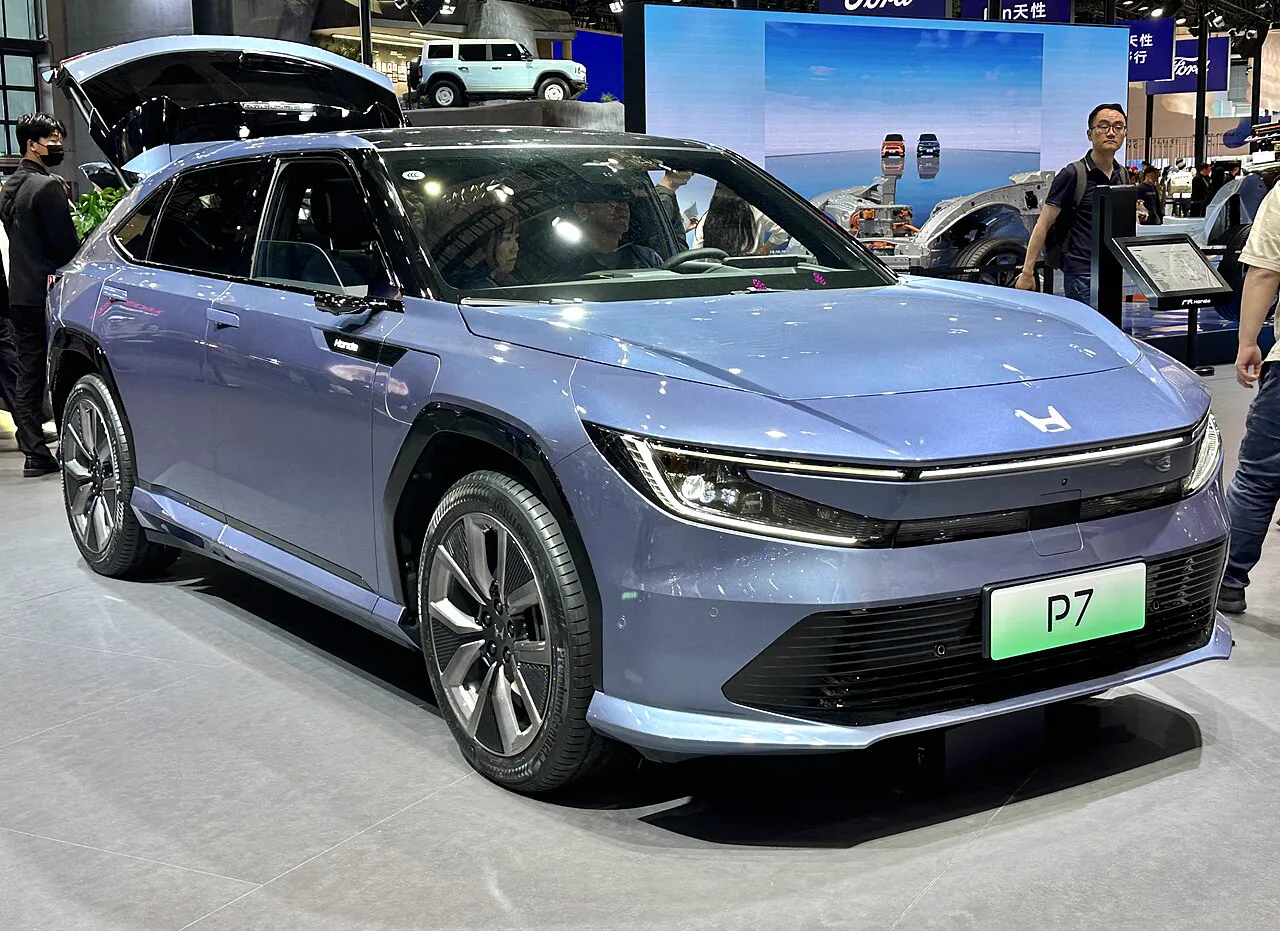
Image: Wikimedia Commons (CC BY-SA 4.0). The GAC Honda P7, built in Guangzhou, China, and on sale there since April 15, 2025 starting at 199,900 yuan. (Yuan prices are Honda China domestic prices, not Canadian prices.) The P7 is not sold in Canada.
Canada formally cut its tariff on Chinese-made electric vehicles from 100% to 6.1% on January 16, 2026, capping imports under a 49,000-vehicle-per-year quota administered by Global Affairs Canada. The first shipment of 24,500 Chinese-made EVs was cleared at Canadian ports in the weeks that followed. The change was a deliberate break with the U.S. 100% tariff posture and created the first real legal channel for affordable Chinese-built EVs into the Canadian market. Reuters, January 16, 2026 · Canada Gazette, SOR/2026-32, March 11, 2026
Japanese press reported in March 2026 that Honda plans to import China-built electric vehicles into Japan, with e:N-branded SUVs from its GAC Honda and Dongfeng Honda joint ventures adapted to Japanese specifications. Honda has not published a release confirming this plan, so treat it as reporting rather than an announced product decision. The e:Ny1 (the export-name for the China-built electric SUV) is already on sale in Europe, the U.K., Australia, and New Zealand — but not in Canada. Nikkei / DoNews, March 4, 2026 · Drive, 2025
Honda’s China EV lineup is broader and more developed than the Canada lineup by a wide margin. The e:N brand launched in 2022 with the e:NS1 from Dongfeng Honda (on sale April 26, 2022) and the e:NP1 from GAC Honda, on Honda’s own e:N Architecture F with a 510 km CLTC range. The e:NP2 followed from GAC Honda in April 2024 (545 km CLTC) and the e:NS2 from Dongfeng Honda in June 2024. Then came the Ye (炫) brand, announced by Honda China in April 2024: Dongfeng Honda launched the S7 on March 6, 2025 at 259,900 yuan for the single-motor Pioneer trim and 309,900 yuan for the dual-motor Navigator, and GAC Honda launched the P7 on April 15, 2025 at 199,900 / 218,900 / 249,900 yuan across three trims. The P7 comes out of GAC Honda’s new Guangzhou NEV factory — roughly 120,000 units a year, in operation since December 23, 2024 — while the S7 is a Dongfeng Honda car. Honda plans a total of 10 Honda-brand EV models in China by 2027. All prices here are Honda China domestic yuan prices; I am not converting them to Canadian dollars, because an exchange-rate conversion is not a Canadian price and goes stale the week it is published. Honda global newsroom, e:N series launch · Honda, Ye brand announcement · GAC Honda Guangzhou NEV plant · Honda China — P7 launch · Honda China — S7 launch
The lineup gap in Canada, June 2026
- Honda EVs sold in Canada today: Honda Prologue (built in Mexico by GM, on the Ultium platform, not a Honda-developed EV).
- Toyota EVs sold in Canada today: Toyota bZ4X (also a joint-architecture EV), with the new generation and a bZ Woodland / bZ Sedan reportedly in the pipeline for 2026–2027.
- Honda EVs built and sold in China right now: e:NS1, e:NP1, e:NP2, e:NS2, Ye P7, Ye S7, and the planned Ye GT — all Honda-developed, all on dedicated EV platforms.
- Honda’s next Honda-developed EV for North America: the 0 Series, with the 0 Saloon and 0 SUV slated for a North American launch in 2026–2027. Canada has not been formally named in the launch order.
Why the Canada tariff window is the unlock
The trade door is already open. A 6.1% MFN tariff on Chinese-made EVs is a working import cost, not a symbolic one. The 49,000-vehicle annual quota is the size of a small automaker’s total Canadian volume, and Global Affairs Canada has been issuing shipment-specific permits since March 1, 2026. The first 24,500 EVs are already in country. The mechanism exists; the precedent exists; the only question is whether Honda Canada chooses to use the mechanism for its own China-built product.
Honda is already proving the import path works. The Japan launch this spring is the proof-of-concept. Honda is taking China-built e:N models, putting them through Japan-market homologation (right-hand drive, JIS safety standards, Japanese-language HMI), and putting them in Japanese showrooms. The North American homologation path is different but no harder — the e:Ny1 already meets European UNECE regulations and is sold in the U.K., which uses many of the same CMVSS/FMVSS-adjacent tests as Canada.
Why the lineup gap matters in Vaughan
This is the part of the story I see from the floor. Right now, a Vaughan shopper who wants a Honda EV has exactly one choice: the Prologue. It is a competent crossover, but it is built in Ramos Arizpe, Mexico, on a General Motors Ultium battery architecture that Honda did not develop. If the same customer says “what else do you have that is a pure EV?” the honest answer today is: nothing. There is no Honda-developed small EV, no Honda-developed sporty EV, no Honda-developed performance EV on the lot.
Compare that with the Toyota corner. Toyota already sells the bZ4X in Canada, and the next-generation Toyota EVs are coming with more variety across the lineup. From a salesperson’s seat, that is the harder thing to defend on the showroom floor. A customer cross-shopping a Toyota bZ and a Honda Prologue is not comparing two equivalent lineups — they are comparing one full lineup to a single nameplate.
The argument for Honda Canada to import a China-built e:Ny1 or Ye P7 is the same argument Honda Japan used: a mature product is already on the line, the capacity is there, and the home market is under-served. Adding a $33,000–$42,000 CAD Honda-developed EV to the Canadian lineup closes the gap in one move. It also gives Honda Canada a real answer to the Chinese brands that are now arriving under the 6.1% tariff — including the BYD, Geely, and MG products that the May 16, May 27, and June 13 briefs on this site already covered.
What the buyer math actually looks like
For a Vaughan shopper comparing options in 2026, the price positioning of a China-built Honda EV would matter more than the badge. Three comparison lines, all in CAD before taxes:
Honda Civic Hybrid (built in Alliston): starting MSRP about $33,000–$40,000. Hybrid, not a pure EV. 200 hp combined, 4.7–5.0 L/100 km combined, no plug-in. Lease-friendly, Honda Canada financing incentives active through summer 2026.
Honda Prologue (built in Mexico, Ultium platform): starting MSRP $59,990 (EX AWD). Pure EV, 85 kWh battery, up to about 473 km of range on the AWD trim. Bigger, heavier, and not Honda-developed.
Honda e:Ny1 (built in China, would need Canada import): Europe MSRP starts at €35,000. Honda does not publish a China-domestic price for the e:Ny1 outside China, so I am not quoting a converted figure — an exchange-rate conversion is not a Canadian price. If Honda Canada used the 6.1% quota channel to bring the e:Ny1 in, the realistic Canadian price would land in the low-$40,000s — closer to a loaded Civic Hybrid than to a Prologue, and competitive with the Tesla Model 3 (China-built) at $39,490.
Honda P7 (built in China): starting price 199,900 yuan in China (a Honda China domestic price, not a Canadian one). Mid-size electric crossover, up to 650 km CLTC, available in single-motor and dual-motor variants. The Ye P7 is the model that would put Honda directly into the Tesla Model Y / Toyota bZ Woodland price range with a Honda-developed product.
Honda China EV lineup — the realistic import candidates
- Honda e:Ny1 — 204 PS (150 kW), 68.8 kWh battery, up to 412 km WLTP, compact electric crossover. On sale in Europe, U.K., Australia, New Zealand. Not sold in Canada.
- Honda e:NP2 / e:NS2 — compact electric crossovers on Honda’s e:N Architecture F; the e:NP2 (GAC Honda, April 2024) is rated 545 km CLTC and the e:NS2 (Dongfeng Honda) followed in June 2024. Honda has not published a release tying either car to the Insight nameplate sold in Japan.
- Honda P7 (GAC Honda) — mid-size electric crossover, up to 650 km CLTC (single-motor) / 620 km (dual-motor), CATL 90 kWh, 9.9-inch digital cluster with AR head-up display. Launched April 15, 2025 at 199,900 / 218,900 / 249,900 yuan across three trims.
- Honda S7 (Dongfeng Honda) — mid-size electric crossover, CATL 89.8 kWh, 650 km CLTC single-motor / 620 km dual-motor. Launched March 6, 2025 at 259,900 yuan (single-motor Pioneer) and 309,900 yuan (dual-motor Navigator).
- Honda Ye GT (planned 2026) — flagship performance variant, GT-badged, expected above the Ye S7 in price and output.
The five models, in photos
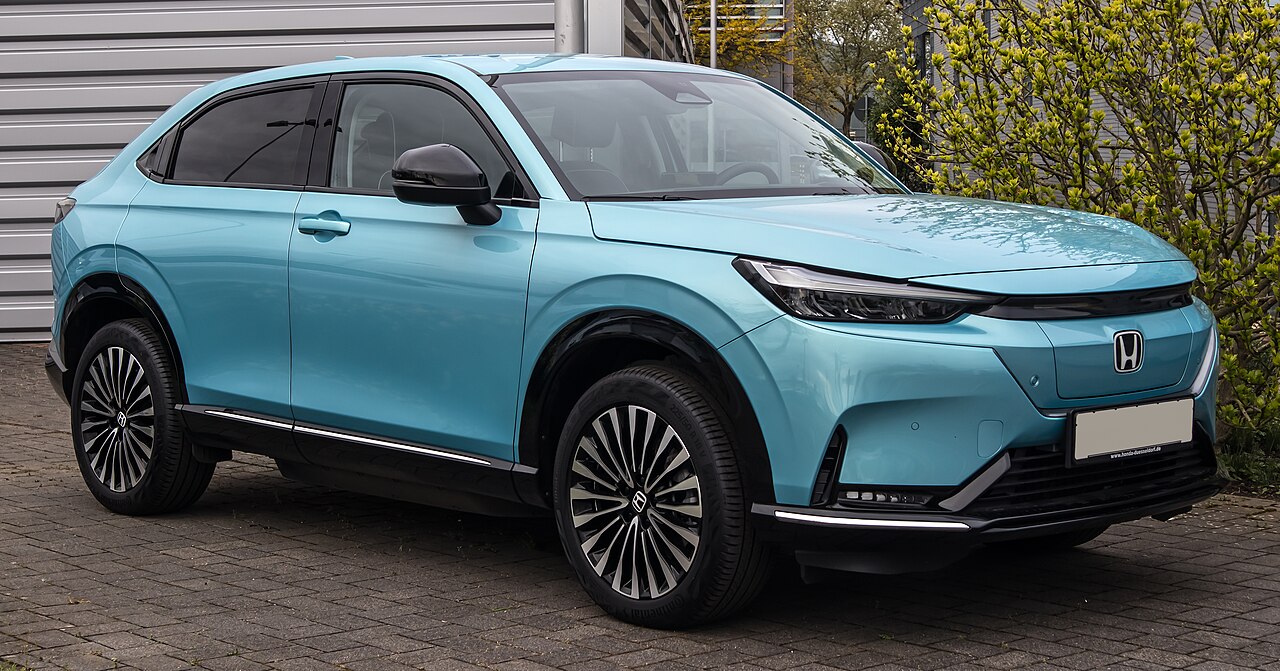
Image: Wikimedia Commons (CC BY-SA 3.0 DE, © M 93). Honda e:Ny1, on sale in Europe, the U.K., Australia, and New Zealand, built in Wuhan by Dongfeng Honda. Not sold in Canada.
Honda e:Ny1
201 hp, 68.8 kWh, 412 km WLTP. Compact electric crossover. China-domestic price band: ~$33,000–$41,000 CAD. Currently the most-likely candidate for a 2027 Canadian import.
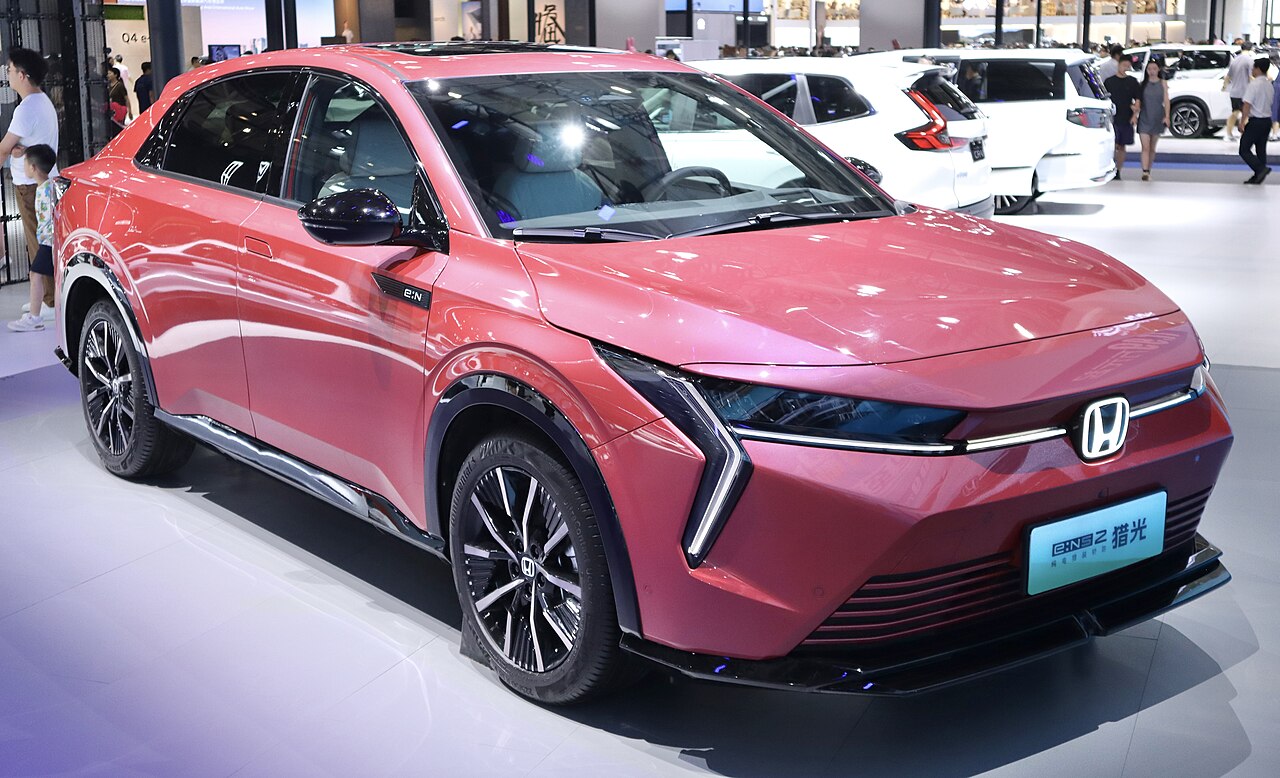
Image: Wikimedia Commons (CC BY-SA 4.0, © User3204). Honda e:NS2, built by Dongfeng Honda in Wuhan. Sold in China since June 2024 and now re-exported to Japan as the Honda Insight and to Thailand as the Honda e:N2.
Honda e:NS2 / e:NP2
204 hp, 68.8 kWh, 545 km CLTC. Compact electric crossover on Honda’s e:N Architecture F. China-domestic price band: ~$35,000–$42,000 CAD. Sister to the e:NP2 from GAC Honda.
Image: Wikimedia Commons (CC BY-SA 4.0). GAC Honda P7, built in Guangzhou. On sale in China since April 15, 2025, starting at 199,900 yuan (Honda China domestic price).
Honda Ye P7
Single-motor rear-drive or dual-motor all-wheel drive (front 150 kW + rear 200 kW, 0–100 km/h in 4.6 s), CATL 90 kWh, 650 km CLTC single-motor / 620 km dual-motor. Mid-size electric crossover, 199,900–249,900 yuan in China.
Image: Wikimedia Commons (CC BY-SA 4.0). Honda S7, the Dongfeng Honda sister of the GAC Honda P7, on the floor of Auto Guangzhou in November 2025. CATL 89.8 kWh, up to 650 km CLTC.
Honda Ye S7
CATL 89.8 kWh, 650 km CLTC single-motor / 620 km dual-motor. Mid-size electric crossover, launched March 6, 2025 at 259,900 yuan (single-motor) and 309,900 yuan (dual-motor). Sits above the P7 in the lineup.
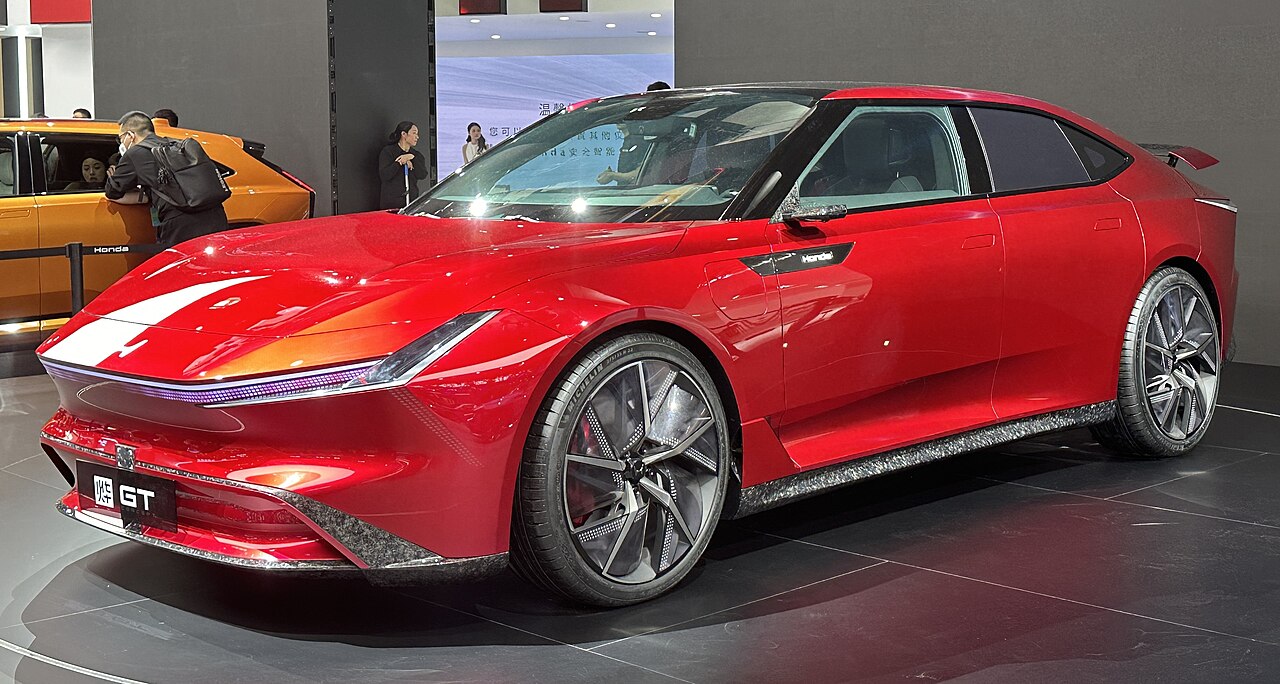
Image: Wikimedia Commons (CC0, © JustAnotherCarDesigner). Honda Ye GT, the planned performance flagship shown as a concept at Auto China 2024. Production expected in 2026, above the Ye S7 in price and output.
Honda Ye GT
Flagship performance electric sedan / liftback concept. Production target: 2026. Honda has not yet confirmed Canadian export plans; if it follows the Ye P7 import playbook, 2027 model year is the earliest window.
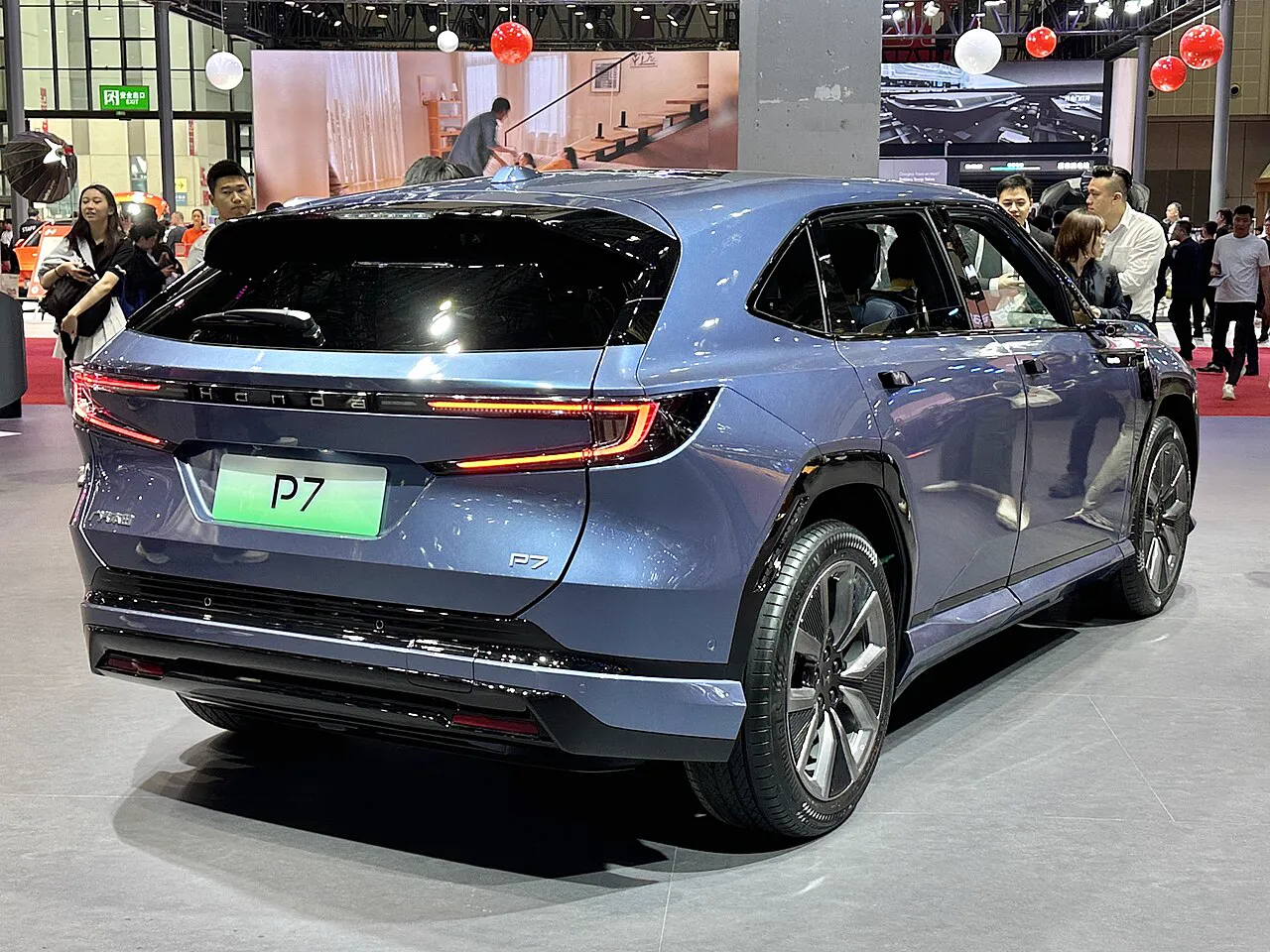
Image: Wikimedia Commons (CC BY-SA 4.0). The Ye P7 rear, with the full-width light bar and the Honda wordmark in place of the H badge — a small but telling departure from the Honda badge on CR-V and Civic.
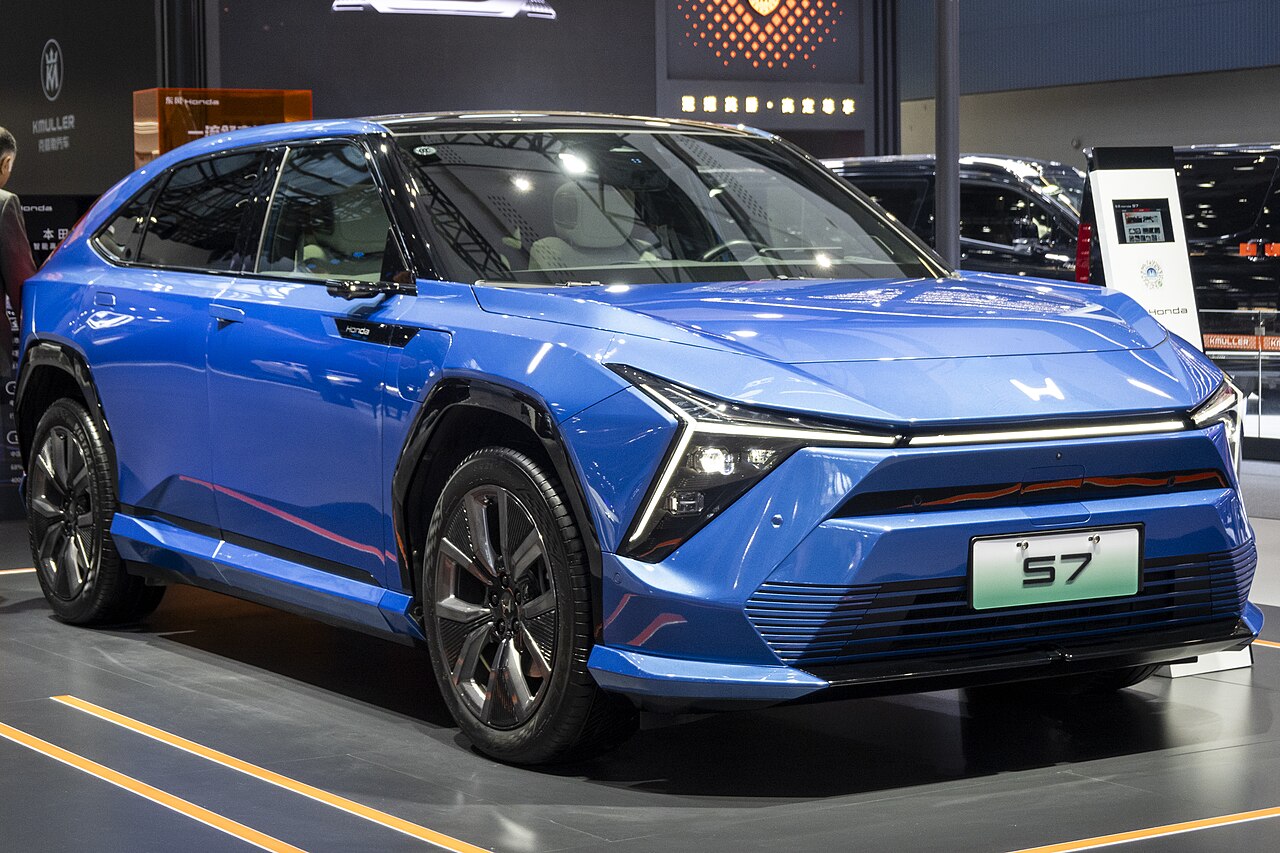
Image: Wikimedia Commons (CC BY-SA 4.0). The Honda S7, the Dongfeng Honda sister of the Ye P7, on the floor of Auto Guangzhou in November 2025. The S7 is the higher-output variant — 469 hp, 620 km CLTC range.
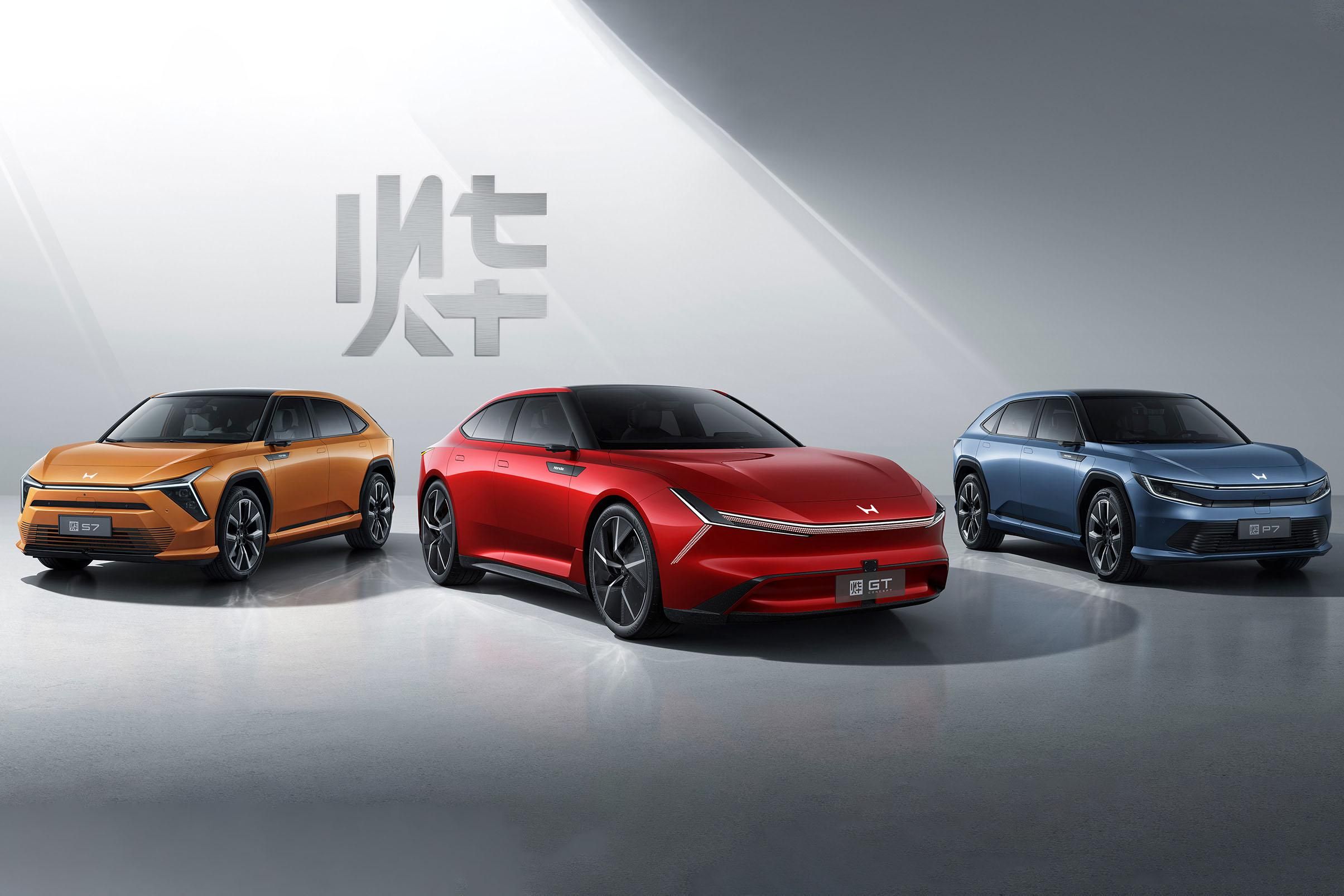
Image: CarExpert (editorial use). The full Honda Ye P7, Ye S7, and Ye GT concept family on stage at Auto China in Beijing in April 2024. The Ye GT is the planned performance flagship for 2026.
Why the strategic argument holds — and what could still stop it
What supports the move: the Canada tariff window is open and is not expected to close under the current Carney government. Honda is already running the import playbook in Japan. The 120,000-unit-per-year Guangzhou plant that makes the Ye P7 and Ye S7 has spare capacity because Honda’s China sales are well off their 2020 peak. The product is homologation-ready for most major markets. A $38,000–$42,000 CAD Ye P7 would slot cleanly between the Civic Hybrid and the CR-V Hybrid in the Honda Canada lineup, and would give the Prologue a real Honda-developed sister model.
What could still block it: Honda Canada’s stated strategy right now is hybrid-first through 2030, with the North American Honda-developed 0 Series EVs scheduled for 2026–2027. Bringing in a China-built Honda EV could compete with the 0 Series launch in 2026–2027. Brand-positioning questions are real — “Made in China” is a harder sell for some Canadian buyers than “Made in Japan” or “Built in Alliston.” Honda Canada’s dealer network, including Maple Honda, is built around the existing lineup and would need training, parts, and diagnostic support for any new model. And the 49,000-vehicle Canada-wide quota is shared with BYD, Geely, MG, and other Chinese brands, so Honda would have to weigh whether to use quota for a Honda import or let it stay open for direct Chinese-brand competition.
What a Vaughan buyer should actually do this week
Buy what is on the lot now, not what is on a press release. The Civic Hybrid and CR-V Hybrid are the real Honda options in 2026. The Prologue is the only Honda EV in Canada, and it is a competent but GM-architected vehicle. None of the China-built Honda EVs are scheduled for Canadian sale. If you want a pure EV and the Honda badge, the Prologue is what you can buy this month. If you want Honda’s hybrid system and a real Honda-engineered chassis, the Civic Hybrid or CR-V Hybrid is the smarter call.
Do not overpay for a Prologue on the assumption a China-built Honda is coming next quarter. There is no formal announcement, no dealer allocation plan, and no Canadian homologation filing for the e:Ny1, e:NS2, or Ye P7. The most realistic earliest window, if Honda Canada announces an import this year, is 2027 model-year availability with limited initial volume. Plan around that, not around the headline.
If you are cross-shopping a Toyota bZ or a Tesla Model 3 from China, ask about Honda’s quiet option. The Toyota bZ4X is on the lot; the Toyota bZ Woodland is reportedly on the way. The Tesla Model 3 from China is at $39,490 and was already a real cross-shop in the May 27 brief. The honest Honda-floor answer right now is: “Today the Prologue is the only Honda EV. If a China-built Honda EV comes, it would likely arrive in 2027 at the earliest. If you can wait and the Prologue does not fit, the right move is to compare the Prologue against the bZ4X and the Model 3 directly, and let the deal — not the badge — make the call.”
My prediction: Honda Canada will formally announce a China-built Honda EV for the Canadian market in the next 12 months — most likely the Ye P7 or the e:NS2 rather than the e:Ny1, because the Ye P7’s mid-size crossover body fits the CR-V Hybrid price band and the e:NS2 fits the Civic Hybrid band. The first Canadian dealer deliveries will not happen before the 2027 calendar year, and initial volume will be limited by the shared 49,000-vehicle China-EV quota. The 0 Series — the Honda-developed North American EV — will continue to be the priority launch, and the China-built Honda will be positioned as a complement, not a replacement, so the two lineups do not cannibalize each other.
Why this matters at the dealership: The Honda EV lineup in Canada is one model right now. A China-built Honda EV would change that overnight — and Honda is already proving the path in Japan, with a 6.1% Canada tariff window wide open. If you are shopping a Honda EV, a Honda hybrid, or cross-shopping a Toyota bZ or Tesla Model 3, this is the strategic story behind the showroom gap. The right move this month is still to buy what is on the lot and lock the deal you can actually get; the right move this year is to keep the Prologue, the Civic Hybrid, and the CR-V Hybrid on your short list while this story develops.
Cross-shopping a Honda EV, a hybrid, or a Toyota bZ?
Maple Honda has the Prologue, the Civic Hybrid, the CR-V Hybrid, and the Accord Hybrid on the lot now. A 20-minute drive covers the real comparison — including the honest answer on what is not yet in the Canadian Honda EV lineup, and what to do about it.
Ask Henry a question
Not ready to book anything? Just ask. Henry Chen answers every message himself — usually within a couple of hours during business hours. No call list, no pressure, and no obligation to buy anything.