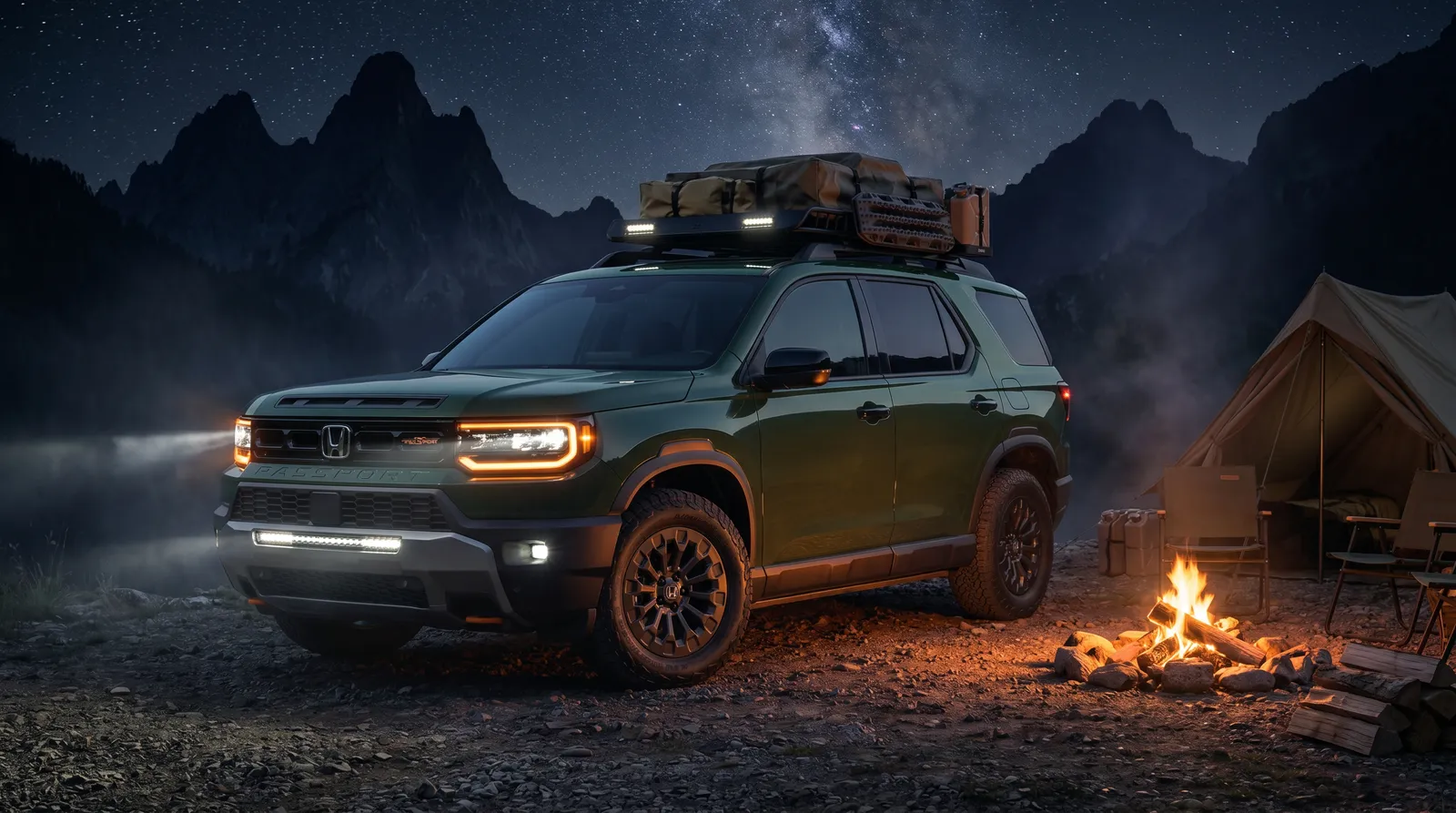
AI-generated concept illustration supplied by Henry Chen, inspired by the 2026 Passport TrailSport - not a Honda press photo or a production accessory configuration. The article discusses a hypothetical Honda off-road SUV, not an announced future vehicle.
The short answer
Yes—I think Honda could earn a place beside the Jeep Wrangler, Ford Bronco, and Toyota 4Runner by building a dedicated off-road SUV with real trail hardware, Honda reliability, and better everyday manners. Honda has not announced this vehicle or an Element revival; this page is my design argument for what it could be.
If Honda ever seriously built a true off-road vehicle, I think the market would respect it.
Not the kind of “off-road edition” where a regular crossover gets black wheels and a roof rack. I’m talking about a real adventure-ready Honda: meaningful ground clearance, all-terrain tires, a rugged body stance, strong traction hardware, exposed protection parts, roof lighting, room for customization, and ideally a bit of electrified torque.
Look at this concept image. The feeling is right. It looks ready for a mountain trail, but it still looks like something a Honda owner could commute in Monday morning.
Why a serious Honda off-road SUV makes sense now
This is no longer a completely disconnected idea. In January 2026, Honda announced a future Trail Line for off-road-oriented production models. Honda said the line is intended to use knowledge from Honda Racing Corporation’s off-road racing activities. Honda also presented TrailSport HRC concepts based on existing SUVs and described the Passport TrailSport Elite as an important Trail Line model. Read Honda’s Trail Line announcement.
That announcement does not confirm the fictional SUV pictured here. It does show that Honda sees off-road driving as more than a temporary styling theme. My question is whether Honda should eventually go one step beyond rugged versions of existing crossovers and create a dedicated adventure vehicle with its own shape, purpose, and community.
The timing also fits how many younger buyers shop. Transportation is only part of the decision. They want a vehicle that supports camping, fishing, cycling, photography, road trips, and weekends outside the city. It needs to carry gear, look good in photos, and represent some personality.
What a true Honda off-road SUV would need
A Honda Wrangler competitor would have to earn its credibility mechanically. Cosmetic toughness would not be enough.
| Must-have idea | Why it matters |
|---|---|
| Real trail clearance | Enough usable clearance and suspension travel for rutted access roads, rocks, mud, and uneven campsites—not just a taller-looking body. |
| Serious traction hardware | A capable 4WD or AWD system with useful low-speed control and locking capability where the engineering supports it. |
| Visible protection | Durable skid protection, recovery points, rock-resistant lower-body pieces, and bumpers designed around actual trail use. |
| All-terrain tire package | Proper sidewalls, sensible wheel sizes, and room for owners to choose more aggressive tires without fighting the bodywork. |
| Accessory-ready design | Factory-supported mounting solutions for roof gear, lighting, camping equipment, recovery tools, and storage. |
| Electrified low-speed torque | A hybrid system could deliver smooth response at low speed while keeping the vehicle efficient and quiet in ordinary driving. |
| Useful, washable cabin | Flexible cargo space, durable surfaces, physical controls, smart tie-down points, and storage designed for muddy gear. |
It doesn’t need to become a Wrangler, and it doesn’t need to copy the Bronco. Those vehicles already have distinct identities. If Honda does this, Honda should build it with its own personality.
The Honda personality could be the advantage
Honda’s biggest strength has rarely been being “the most extreme.” It has been building vehicles that feel durable, thoughtful, refined, and easy to live with over time. Bringing that philosophy into a more serious off-road SUV could be the point—not a compromise.
The vehicle I imagine would be capable enough for trails, dirt roads, campsites, fishing spots, snowy cottage routes, and sunset viewpoints, but quiet and settled enough for Highway 400. It would have real physical protection and usable recovery equipment without making every school run feel like an expedition.
That everyday balance could separate a rugged Honda SUV from traditional off-road icons. Some buyers want the look and capability but do not want removable doors, a harsh ride, or a vehicle that feels specialized every day. Honda could serve that buyer without pretending a regular crossover is suddenly a rock crawler.
What is the closest Honda off-road SUV today?
For Canadian buyers, the Honda Passport TrailSport is the closest current answer. It already brings the Passport line much closer to the outdoor, trail-ready personality I am describing. The Pilot adds family space, while the CR-V remains the more efficient everyday choice.
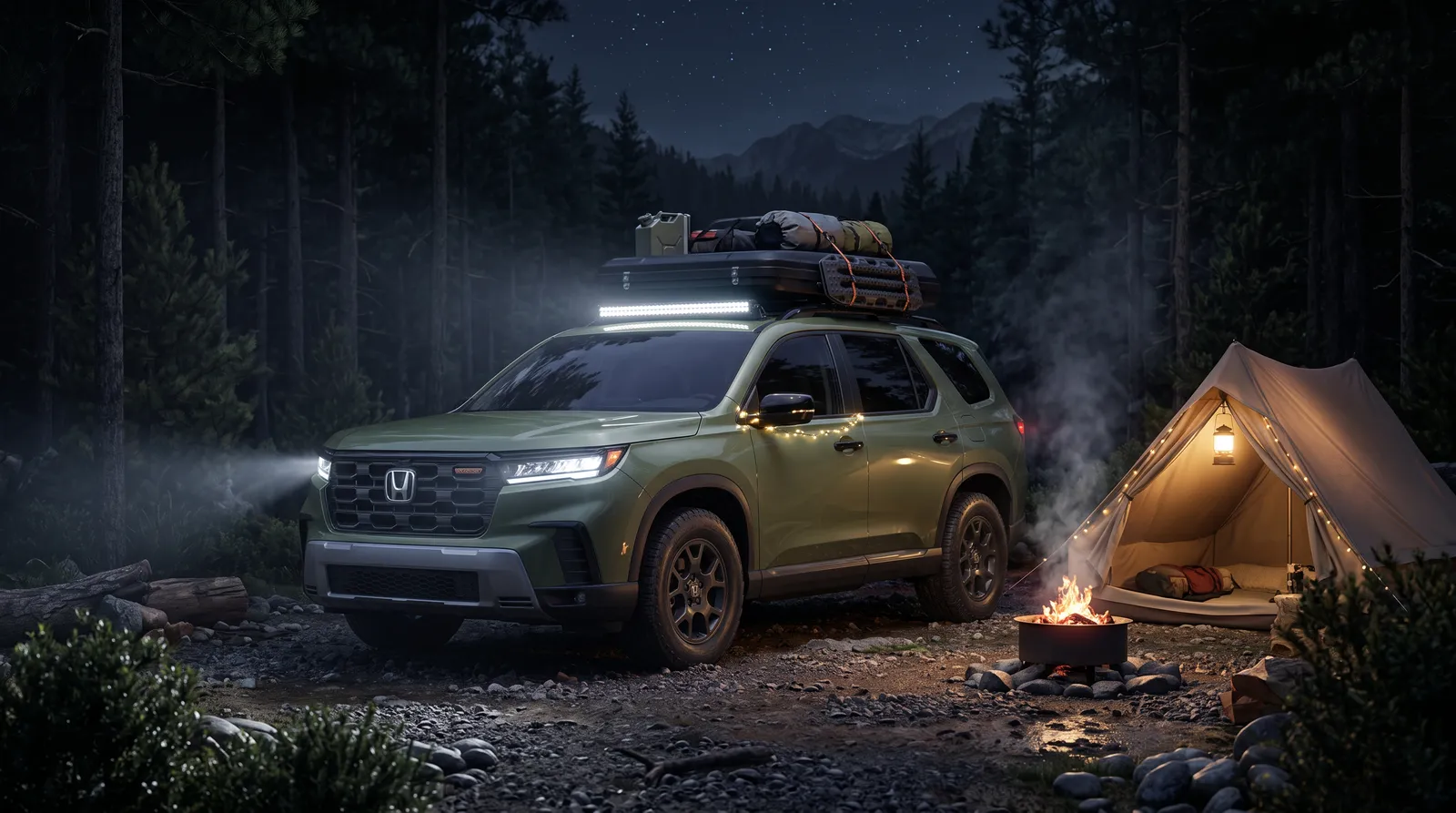
AI-generated 2026 Honda Pilot TrailSport lifestyle illustration supplied by Henry Chen. It shows the kind of family-adventure use case Pilot TrailSport buyers often imagine.
But there is still room in the imagination for something more focused: shorter overhangs, a more upright body, easier accessory mounting, greater customization, and a design created around adventure from the first sketch. That would be a new category for Honda rather than another trim package.
Could this be a new Honda Element?
The Honda Element still has a loyal following because it was different, practical, boxy, and easy to adapt to active life. Honda Canada does not list an Element among its current or future vehicles as of July 14, 2026, so an Element return remains unconfirmed. See Honda Canada’s official future-vehicle page.
Still, if the name ever came back, could Honda use it for something like this? A modern Element could keep the original idea of flexible utility while adding stronger trail ability, hybrid torque, modern safety technology, and an accessory ecosystem designed for camping and outdoor hobbies.
Or perhaps Honda should use a completely new name and let the Element remain its own thing. I can see both arguments. The important part is that the vehicle would need a clear identity—not simply a familiar badge placed on another crossover.
Honda off-road SUV questions
Does Honda make a true off-road SUV?
The Passport TrailSport is Honda’s closest current Canadian-market answer, but Honda does not currently offer a body-on-frame Wrangler-style SUV in Canada. This article imagines a more dedicated Honda off-roader.
Is Honda bringing back the Element?
Honda Canada has not announced an Element return. The Element discussion here is speculation about how the name could fit a future rugged, flexible Honda.
What is Honda Trail Line?
Honda announced Trail Line in January 2026 as a future line of off-road-oriented production models intended to incorporate knowledge from Honda Racing Corporation’s off-road racing activities. Honda has not said that the AI concept on this page is part of that program.
What would a true Honda off-road SUV need?
My list starts with meaningful ground clearance, durable underbody protection, all-terrain tires, recovery points, strong traction hardware, useful cargo space, accessory support, and everyday refinement.
Would it compete with the Jeep Wrangler and Ford Bronco?
That is the market position I am imagining, but with a different Honda personality: less focused on being the most extreme and more focused on reliability, refinement, flexible utility, and daily comfort.
Source note: Current-product references use Honda Canada. The Trail Line description uses Honda Motor Co.’s official January 9, 2026 announcement. The vehicle pictured and all proposed specifications are Henry Chen’s AI-assisted design concept and opinion—not Honda product information.
Now I want your answer: What would you call it? Which three features would be non-negotiable? If Honda built a true Wrangler-style off-road SUV with better daily manners, would you buy it?
Would you buy this Honda?
Tell me what you would call it, which features it would need, and whether you would choose it over the established off-road SUVs.