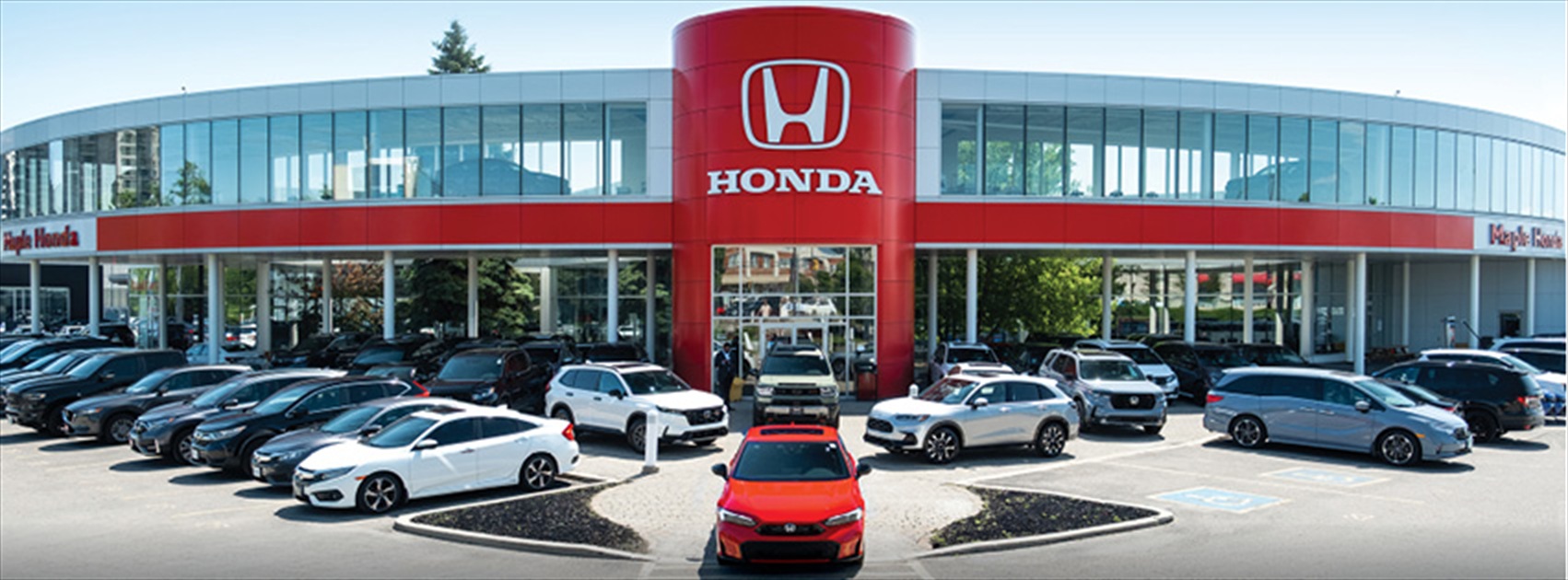
Photo: Maple Honda in Vaughan, where the maintenance-cost conversation usually starts before the test drive.
Honda Canada's Maintenance Minder does not simply count kilometres. Honda says it estimates engine oil life using operating inputs such as speed, temperature, and more severe operating conditions, then alerts the driver when estimated oil life reaches 15%. It can also display additional codes for tires, brakes, filters, spark plugs, and other fluids. Honda Canada — Maintenance Minder
If you are comparing Civic, HR-V, CR-V, Accord, Pilot, Passport, Odyssey, or Ridgeline, the maintenance budget is not one number. It is five buckets. Some are predictable. Some depend heavily on driving style. Some are warranty questions, not maintenance questions at all.
The five cost buckets I want buyers to understand
| Cost bucket | What it includes | How to think about it |
|---|---|---|
| Routine Minder visits | Oil, oil filter, inspection, tire rotation, cabin and engine filters when codes appear. | The predictable part. Your dash tells you when it is due, and the code tells the service advisor what to quote. |
| Wear items | Tires, brake pads, rotors, wipers, 12V battery, alignment. | The variable part. Highway commuters and short-trip city drivers can own the same CR-V and see different brake/tire timing. |
| Time-based service | Brake fluid, certain inspections, age-related items. | Low-kilometre drivers still need this. A car can age while parked. |
| Seasonal Ontario costs | Winter tires, storage, swaps, underbody wash, salt-related wear checks. | Vaughan reality. The car may be reliable, but winter still adds ownership cost. |
| Unexpected repairs | Defect repairs, failed components, collision damage, road-hazard damage. | This is where warranty, extended warranty, insurance, and your own risk tolerance matter. |
The key is separating maintenance from repairs. Maintenance is what you do because the car is working normally. Repairs are what you do because something failed or got damaged. A lower-maintenance car does not mean "no cost"; it means fewer surprises and a service schedule you can plan around.
What warranty covers, and what it does not
Honda Canada's standard warranty page lists the main new-vehicle coverage layers: 3 years / 60,000 km distributor's warranty, 5 years / 100,000 km powertrain warranty, and 8 years / 160,000 km hybrid system warranty on covered hybrid components. Honda Canada — Standard Warranty
That is important, but it is not the same as free maintenance. Oil, filters, tires, brake wear, wiper inserts, brake fluid, and ordinary wear inspections are normal ownership costs. Warranty is there for defects in material or workmanship within the term. Maintenance is your responsibility.
Sales-floor translation
If a buyer asks, "What will this Honda cost me after the payment?", I separate it like this: routine Minder service is the planned cost, tires and brakes are the driving-style cost, and warranty is the backstop for defects. Mixing those three together makes the car feel more expensive than it really is.
Gas, hybrid, and EV: the maintenance difference
Honda hybrids are not maintenance-free. They still have tires, brakes, cabin filters, engine oil, coolant, brake fluid, and inspections. But they can simplify some ownership conversations because the hybrid system is covered by a separate 8-year / 160,000 km warranty layer and because regenerative braking can reduce brake wear for some drivers.
The biggest hybrid mistake is assuming every cost goes down. Fuel cost usually goes down. Brake wear may go down, depending on driving pattern. Tire cost does not automatically go down. If the hybrid trim uses a larger wheel or heavier curb weight, tires can still be a meaningful line item.
EVs move the conversation again. No engine oil, but tires, 12V battery, brake service, cabin filters, charging setup, and winter range planning still matter. For most Vaughan Honda shoppers in 2026, the practical low-surprise ownership path is still Civic Hybrid or CR-V Hybrid if the driving pattern fits.
Why Vaughan driving changes the answer
A maintenance budget for Vaughan is different from a maintenance budget for a flat, mild-climate highway town. Here are the patterns I see most often:
- Short trips are harder than they look. A school run, plaza stop, and quick grocery loop may add only a few kilometres, but the engine does not always reach full operating temperature. The Minder can come up sooner than the odometer alone suggests.
- Highway 400 stop-and-go is not true highway driving. The car may be on a highway, but repeated braking and acceleration still affect brakes, tires, fuel use, and oil-life calculation.
- Winter tires are not optional math. You can skip them, but then you pay with grip, braking distance, and confidence. A five-year ownership budget should include winter rubber, not treat it as a surprise.
- Salt makes inspections valuable. The Minder does not monitor rust, seized hardware, stone chips, or underbody salt exposure. A clean inspection catches small problems before they become expensive ones.
How I would budget a new Honda over five years
I would not build the budget from a single "oil change price." I would build it from annual kilometres and ownership style:
- Under 12,000 km/year: Watch time-based items. Low kilometres do not mean zero service. Brake fluid, battery health, and tire age still matter.
- 12,000 to 20,000 km/year: This is the cleanest ownership profile. Plan for regular Minder visits, winter tire costs, and wear items on a normal timeline.
- 20,000+ km/year: Maintenance becomes part of the purchase decision. Fuel economy, tire size, brake wear, and resale value matter more than the first monthly payment.
- Lease customer: Think in lease-end condition. Tires, brakes, windshield chips, dents, and scheduled service records can affect the handoff.
- Finance customer keeping 7+ years: Think past warranty. A Honda can be the right long-term car, but the plan should include brakes, tires, fluids, and eventually battery/charging-system checks.
My prediction: By October 31, 2026, more Vaughan Honda buyers will ask for a five-year ownership-cost estimate before choosing a trim, because insurance, tires, winter setup, and service timing now feel like part of the payment conversation, not an afterthought.
My prediction: By January 31, 2027, hybrid shoppers will stop asking whether Honda hybrids are "expensive to maintain" and start asking which hybrid trim has the best total-cost mix of fuel, tire size, warranty runway, and resale value. That is the right question.
When a maintenance plan or extended warranty makes sense
A maintenance plan makes sense when predictability matters more than trying to win every individual invoice. If you are budgeting tightly, buying for a family member, or leasing and want clean records at turn-in, pre-planned maintenance can be useful.
An extended warranty is a different decision. Honda Canada says Honda Plus Extended Warranty can offer coverage options up to 8 years / 200,000 km, but whether it is worth it depends on how long you keep the vehicle, your kilometres, whether you are buying new or used, and how comfortable you are with repair risk after the original warranty ends. Honda Canada — Honda Plus Extended Warranty
My honest rule: if you trade every three or four years, you probably care more about clean maintenance records than extended repair coverage. If you keep vehicles seven to ten years, warranty runway and maintenance discipline both matter.
Quick answers
Does Honda warranty cover oil changes?
No. Oil, filters, tires, brake wear, fluid services, and normal inspections are scheduled maintenance or wear items. Warranty covers covered defects within the warranty term.
Should I follow kilometres or the Maintenance Minder?
Follow the Maintenance Minder and your owner's manual. Honda Canada's owner page explains that the Minder estimates oil life from operating conditions and displays additional service codes when needed.
Are Honda hybrids more expensive to service?
Not automatically. They still need normal maintenance, but the covered hybrid system has its own warranty layer. The bigger cost variables are usually tires, kilometres, winter setup, and driving pattern.
What is the one cost buyers forget?
Winter tires. In Vaughan, a realistic Honda ownership budget should include winter tires, swaps or storage, and periodic inspection for salt-related wear.
Does Honda warranty cover scheduled maintenance?
No. Honda Canada's standard warranty covers defects in materials and workmanship within the stated warranty terms. Scheduled maintenance items such as oil, filters, tires, brake wear, and fluid services are normal ownership costs.
How does Honda decide when my car needs service?
Honda Canada's Maintenance Minder estimates oil life from operating conditions and alerts the driver when service is due soon, including oil, oil filter, and additional code items such as tires, brakes, filters, spark plugs, and fluids.
What should a Vaughan Honda owner budget for?
Budget for routine Minder visits, winter tire storage or swaps, wear items such as brakes and tires, and time-based items such as brake fluid. The exact amount depends on model, driving pattern, mileage, and current parts pricing.
Are Honda hybrids more expensive to maintain?
Not automatically. Honda Canada lists an 8-year / 160,000 km Hybrid System Warranty, and Honda hybrid vehicles do not have every traditional belt-driven accessory found on older gas setups. Tire, brake, fluid, and filter costs still depend on model and driving pattern.
Want the ownership-cost view before you choose?
Send me the model you are considering, your yearly kilometres, and whether you lease or finance. I will walk through the maintenance, tire, warranty, fuel, and resale side before you decide on the trim.
Ask Henry a question
Not ready to book anything? Just ask. Henry Chen answers every message himself — usually within a couple of hours during business hours. No call list, no pressure, and no obligation to buy anything.