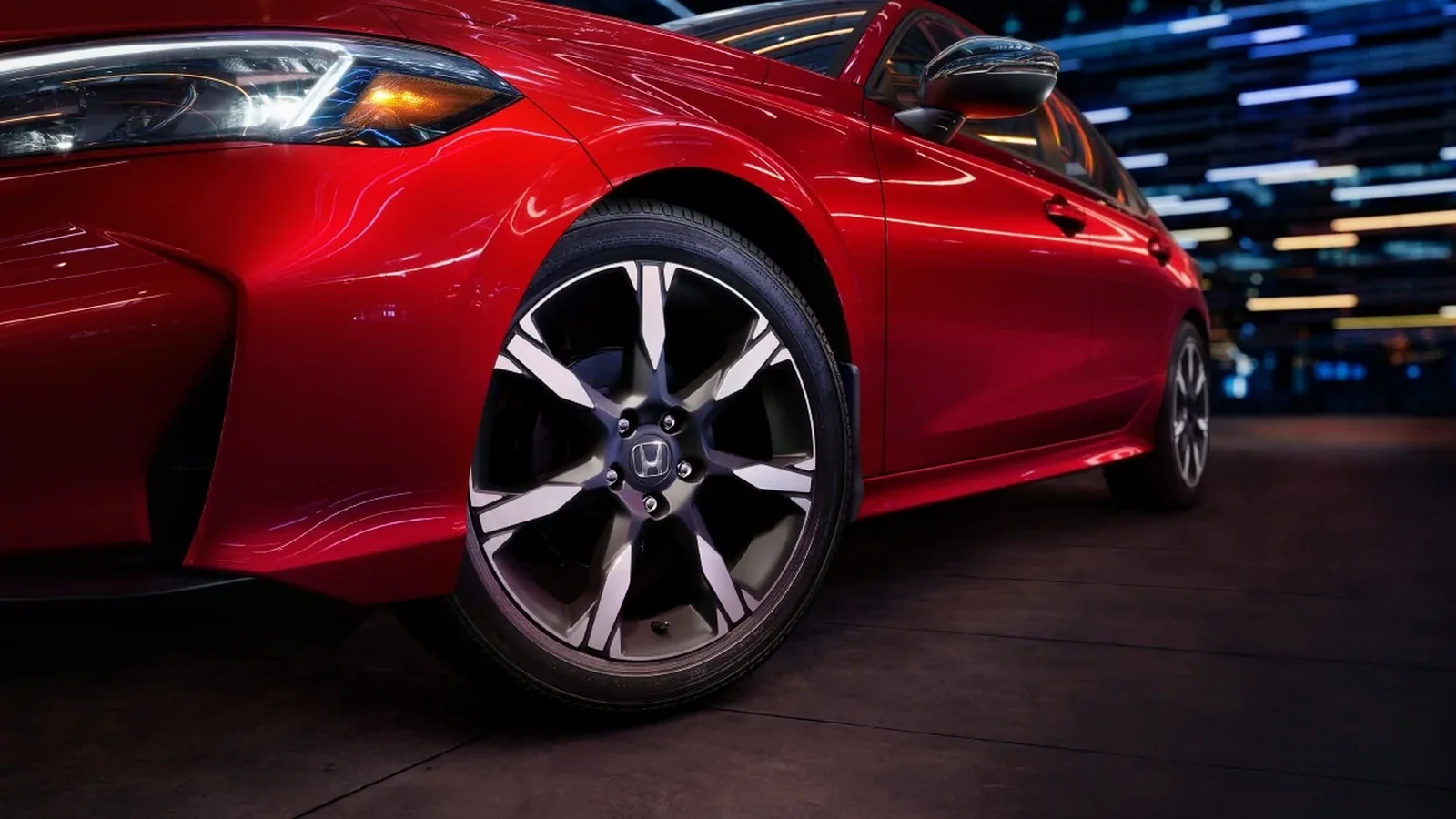
Photo: Honda Canada. 2026 Honda Civic Sedan exterior styling.
I work with new-driver families every spring, and the same five questions come up. We’ll go through each one.
The Ontario G1 → G2 → G roadmap
G1 (Level 1): written knowledge test + vision test. Minimum age 16. Must have a fully licensed driver (4+ years experience, G class) in the passenger seat at all times. Zero alcohol — G1 drivers face a 24-hour licence suspension at any BAC over 0.00.
G2 (Level 2): road test. Can be written 12 months after G1, or 8 months after G1 if the driver completed an MTO-approved Beginner Driver Education (BDE) course. Restrictions: zero alcohol, only 1 passenger aged 19 or under between midnight and 5am for the first six months (after six months, up to three passengers aged 19 or under; immediate-family and fully licensed accompanying-driver exceptions apply), no highway driving restriction (removed in some cases for BDE graduates).
G (full licence): second road test. Can be written 12 months after G2. BDE shortens the G1-to-G2 wait, but it does not shorten the G2-to-G wait. Zero alcohol restriction ends at G. Full driving privileges.
The BDE fast-track math: BDE course costs roughly $400–700 in the GTA. It cuts the G1→G2 wait from 12 months to 8 months. The insurance discount (5–15% on most Ontario policies) usually pays back the BDE cost in 12–18 months.
Where to do BDE in the GTA: most DriveTest-licensed driving schools offer MTO-approved BDE. Pick one with a classroom component (online-only is not eligible for the insurance discount in Ontario). Total course time is 34 hours classroom + 10 hours in-car.
My honest take: if your teen is going to drive at all in their first year of eligibility, do BDE. It saves a year of waiting and usually pays back in insurance discount alone.
Insurance math for adding a teen to a family policy
This is the part most parents underestimate. Ontario auto insurance is the largest variable in the monthly cost of a new driver — and it’s almost always more than the car payment for a G2 driver.
Rough Ontario insurance ranges for adding a G2 driver:
- Honda Civic Sedan (2018–2022) — $280–450/month for a 17-year-old G2 driver added to a clean parental policy. The Civic is the cheapest bracket because it’s a compact sedan, lower theft risk, lower injury severity.
- Honda Civic Hybrid (2018–2022) — $260–420/month. Cheaper than gas Civic by $20–40/month because Hybrid drivers tend to have slightly lower claim frequency and the car has lower theft rates.
- Honda Fit (2015–2020) — $240–400/month. The Fit was the cheapest Honda to insure in the subcompact class. Honda discontinued the Fit after 2020, so used inventory is the only option now.
- Honda HR-V (2016–2022) — $320–500/month. The subcompact SUV bracket is $40–70/month higher than Civic because of the SUV injury-severity factor in Ontario actuarial tables.
- Honda CR-V (2017–2022) — $360–550/month. The compact SUV bracket is $80–120/month higher than Civic. Worth skipping for a G2 driver unless cargo needs are real.
- Honda Pilot (2016–2022) — $480–750/month. Three-row SUV bracket is $200–300/month higher than Civic. A G2 driver in a Pilot is over-insured for both the driver and the policy.
These ranges assume a clean parental record, urban Ontario address (GTA), and standard $1,000,000 third-party liability. Rural addresses can be $80–150/month lower; downtown Toronto addresses can be $100–200/month higher.
Discounts to ask the broker about:
- BDE completion certificate (5–15% discount).
- Telematics / usage-based insurance (10–25% if the teen actually drives less than 12,000 km/year).
- Winter tire discount ($50–150/year — even on summer driving when declared).
- Bundling with home insurance ($200–500/year combined savings).
- Pay-in-full annual discount (most insurers charge a monthly installment fee — paying once a year avoids it).
Which used Honda for a new driver
The Civic remains the best first Honda for a new driver because it’s compact (easy to park), fuel-efficient, lower insurance bracket than any SUV, and Hondas hold their value so a used Civic at $14–20k still has $9–12k in 3 years. Used Civic Sedan gas, 2018–2022 — default first-car pick. If you specifically want a Honda hybrid in that used age range, look at Accord Hybrid instead; Civic Hybrid is a newer Canada-market option.
The HR-V is the right pick if:
- The family does outdoor things (camping, mountain biking, ski trips) and needs the cargo.
- The teen wants AWD for winter driving to school in northern GTA (Newmarket, Georgina, northern Richmond Hill).
- Insurance still fits — HR-V is the cheapest SUV in the Honda lineup.
The Fit was the original first-Honda but Honda discontinued it after 2020. If you can find a clean 2015–2020 Fit with under 120,000 km, it remains a strong option for a teen’s bike-and-gear life.
Skip these for the first year:
- Any used CR-V or Pilot. Insurance penalty is real for a new driver, and the car is bigger than the teen likely needs.
- Any 6-cylinder Honda (Ridgeline, Odyssey, older Pilot). V6 fuel cost is higher, insurance is higher, and a new driver doesn’t need the power.
- Any first-year Civic Si or Type R. Fun cars, but the insurance for a G2 driver in a Civic Si is roughly double the Civic gas insurance. Save it for year 3.
- Any Honda with a salvage or rebuilt title. Insurers either refuse to insure these or charge 30–60% more. UVIP ($20 from ServiceOntario) will reveal any branding.
Used Honda buying for a G2 driver — the specific traps
Traps that specifically target first-car buyers:
- The odometer mismatch. UVIP reads the odometer at the last registration event. If the odometer on the car is lower than UVIP says it should be, the odometer has been rolled back — walk away. Criminal Code s.380 carries up to 14 years on indictment.
- The branded title. Salvage / rebuilt / non-repairable / irrecoverable / stolen-recovered titles reduce the value 30–50%. UVIP reveals these. A G2 driver can’t afford to lose that value on the first car.
- The single-owner story that doesn’t add up. "One-owner, lady-driven, garage-kept" at 18,000 km/year for 8 years should be 144,000 km on the odometer. If it’s 86,000 km, the math doesn’t work — ask for the service records.
- The aftermarket mods. Tinted windows, lowered suspension, aftermarket exhaust, big wheels. None of these are illegal but most void the manufacturer’s powertrain warranty. For a new driver, you want stock — fewer surprises.
- The dealer price that won’t come down. Most used-Honda dealers in the GTA price 5–8% above market because they know there’s demand. The OMVIC-registered dealer’s price is negotiable; the curbsider’s price is final.
The 12-month ownership math
For a 17-year-old G2 driver with a used 2019–2022 Civic Sedan gas at $16,000 plus HST + OMVIC fee ($22) + license plate package ($400–500 reference range):
- Monthly payment (financed at 6.9% over 60 months with $0 down): ~$330/month + tax.
- Insurance (added to family policy): ~$320/month.
- Fuel (12,000 km/year at 6.4 L/100 km combined, current Ontario avg ~$1.55/L): ~$100/month.
- Maintenance budget (oil changes, wipers, tires over 12 months): ~$50/month set-aside.
- Total monthly cost: ~$800/month all-in for a first-year G2 driver.
That’s the real number. The Civic payment is the small part — insurance and fuel are the bigger parts. Knowing the total monthly cost before committing helps avoid the “how did we end up here” conversation three months in.
My honest take: the first car is a learning car, not a status car. Civic Sedan at year 1, Civic Hybrid or HR-V at year 3 if the file is strong and the budget supports it. That’s the cleaner newcomer-driver path than jumping straight into the SUV.
After the first year
If the first year goes well — no at-fault accidents, no licence suspensions, on-time insurance payments — the second-year insurance rate usually drops 15–25% as the G2 driver gets older and accumulates Canadian driving history. The third year (now 19, G licence, full coverage eligibility) drops another 10–20%. By year 3, the same G2 driver who started at $320/month is often paying $200–240/month for the same coverage on the same Civic.
That’s the path to the bigger Honda. Build the file for 2–3 years, then upgrade to the CR-V or Pilot. Or stay in the Civic and let the insurance savings compound — both are valid choices depending on what the next 5 years look like.
Frequently asked questions
How much does it cost to add a 17-year-old to my Ontario auto insurance?
For a G2 driver on a family policy with a used 2019–2022 Honda Civic, expect $280–$450/month in the GTA. The exact cost depends on your address, driving record, the make/model/year of the car, and the third-party liability limit you carry. A Honda Civic Hybrid is usually $20–40/month cheaper than Civic gas. A Honda CR-V is usually $80–120/month more than Civic. Honda Pilot is $200–300/month more.
What is BDE and is it worth it for a new driver in Ontario?
BDE (Beginner Driver Education) is an MTO-approved 34-hour classroom + 10-hour in-car course. It cuts the G1→G2 wait from 12 months to 8 months, and the G2→G wait from 12 months to 8 months. The insurance discount on most Ontario policies is 5–15% — which pays back the $400–700 BDE cost in 12–18 months. Most GTA driving schools offer MTO-approved BDE.
Which used Honda is best for a 17-year-old G2 driver in Ontario?
Honda Civic Sedan (2018–2022) is the default. Compact, lower insurance bracket than any SUV, fuel-efficient. Many late-model Civics include Honda Sensing, but availability depends on model year, trim, body style, and transmission. Check the VIN/build sheet before buying. Skip CR-V, Pilot, Ridgeline, or any 6-cylinder Honda for year 1 — insurance penalty is real and the car is bigger than a new driver needs.
Does Honda Sensing help new drivers?
Yes — adaptive cruise control reduces fatigue on the 400-series commute, lane keeping assist reduces drift incidents, collision mitigation braking is a real safety net. Honda Sensing availability varies by model year, trim, and body style — check the specific used Civic's build sheet. For a G2 driver, Honda Sensing-equipped used Civics are the safest first-Honda choice in the segment.
Can a 17-year-old finance a used Honda in Ontario?
Usually yes with a parent co-signer. Honda Financial Services and most major lenders will require the parent to be the primary borrower with the teen as the registered driver. Terms are typically 60–72 months at 6.9–9.9% depending on credit. The co-signed first loan is a great Canadian credit-builder for the teen if payments are made on time.
Is the Honda Fit a good first car?
Yes — the Fit was the original first-Honda for new drivers, with the lowest insurance bracket in the Honda lineup and the Magic Seat rear configuration that handles bike-and-gear life. Honda discontinued the Fit after 2020, so used inventory is the only option now. A clean 2015–2020 Fit with under 120,000 km is the cheapest Honda to insure for a G2 driver in Ontario.
What is the cheapest Honda to insure in Ontario?
Honda Fit (2015–2020) is the cheapest Honda to insure because it’s the smallest, lightest Honda in the lineup and has the lowest theft rate. Honda Civic Sedan is the second-cheapest. HR-V is the cheapest Honda SUV to insure. Pilot and Ridgeline are the most expensive Honda to insure because they’re larger and in different insurance brackets.
Can I put a 17-year-old on my own Ontario policy instead of mine?
Yes — it’s often cheaper to put the teen on their own policy if the parents don’t drive. The teen’s policy will be higher than adding them to a parental policy because the multi-driver and multi-vehicle discounts don’t apply. For a single teen driver with no other family drivers, an own-policy is usually the cleaner setup.
New driver in the family?
Send Henry the teen’s age, licence level (G1 / G2 / G), and your budget range — I’ll match the right used Civic, Fit, or HR-V to the actual situation and quote the insurance math before you commit. Text (647) 523-6878.
Ask Henry a question
Not ready to book anything? Just ask. Henry Chen answers every message himself — usually within a couple of hours during business hours. No call list, no pressure, and no obligation to buy anything.