The first 90 days in Canada set up the next 90 months of your driving life. Get the order right and the rest of the car-buying path is much smoother.
I’ve worked with hundreds of GTA newcomers over the years, and the same five mistakes come up over and over. Buying the car first, insuring the car later, and finding out the insurance is double what you expected — that one is the most expensive. This page is the order I wish every newcomer had on day one.
Week 1 in Ontario — the licence question
If you have a valid driver’s licence from a reciprocal jurisdiction — the list includes the United States, United Kingdom, France, Germany, Australia, Japan, South Korea, Switzerland, Austria, Belgium, Ireland, Taiwan, and a few others — you can exchange it for an Ontario licence at a ServiceOntario DriveTest centre. You have 90 days from establishing Ontario residency to do the exchange per the Ontario Highway Traffic Act.
If you’re from a non-reciprocal country (China, India, the Philippines, most of the Middle East, most of Africa, most of South America), you start at G1 — the knowledge test and vision test — then G2 (road test, 12 months later or 8 months with an approved Beginner Driver Education course), then G (full licence). The G1→G2→G ladder is the standard timeline.
If you have a valid licence from a non-reciprocal country and you’re over 16 with at least one year of driving experience, you may be eligible for the Licence Exchange Program — a fast-track that lets you skip G1 and G2 if you pass an advanced road test and meet the experience requirements. Worth asking about at your first DriveTest visit.
Insurance before the car — the order matters
The newcomer insurance tax is real. Ontario auto insurance is private-market (not government), and the industry charges newcomers more for the first 3 years on the road. Getting quotes before you shop for the car lets you budget honestly for the actual monthly cost — car payment + insurance + HST + fuel + maintenance.
Ontario minimum coverage is $200,000 third-party liability per the Ontario Insurance Act. Most GTA drivers carry $1,000,000 or $2,000,000 — the difference in annual premium is small, and the difference in catastrophic-event protection is huge. Ontario’s no-fault system means your own insurer pays your injury claim regardless of who’s at fault — but you can still be sued for serious injury in excess of your policy limit.
Discounts worth asking about for newcomers:
- BDE (Beginner Driver Education) — if any driver on the policy is a G1/G2 driver, completing an MTO-approved BDE course gives an insurance discount (varies by insurer; typically 5–15%).
- Winter tire discount — most Ontario insurers offer a discount for a declared set of 4 winter tires (usually $50–$150/year off). The discount applies even on summer driving when the policy declares winter tires are installed.
- Usage-based insurance — if you drive less than the GTA average (under 12,000 km/year), a telematics policy can drop your premium 10–25%.
- Multi-policy bundling — home + auto with the same insurer is the most common way to drop your annual premium $200–$500.
Now — the car decision
Once you have your Ontario licence (or at minimum your G1 with a G2-licensed driver), and you have insurance quotes in hand, the car decision becomes much simpler. The car-payment conversation should include the insurance number, not just the sticker price.
What most GTA newcomers end up choosing (in roughly this order):
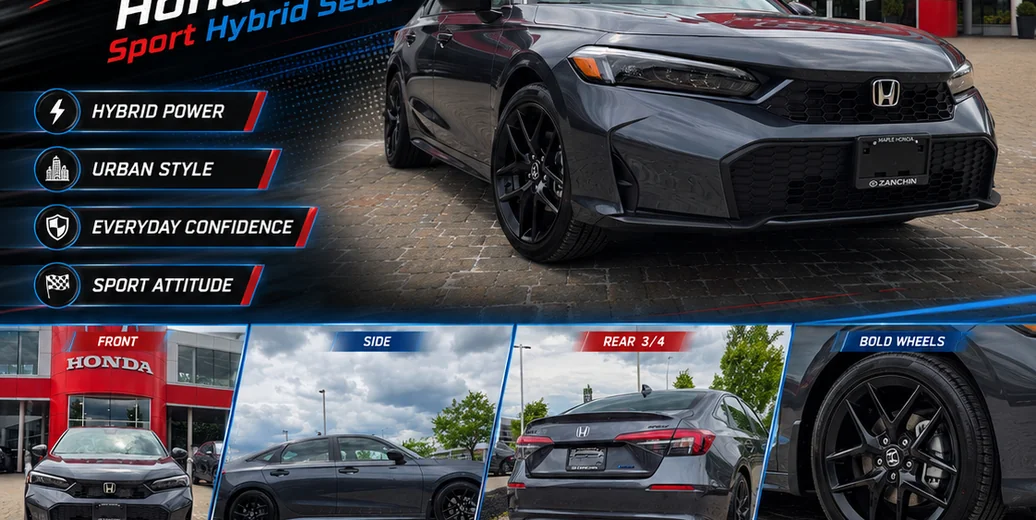
- Honda Civic Sedan (gas or Hybrid) — the default first Honda. 150 hp 2.0L gas at 6.4 L/100 km combined, or 200 hp Hybrid at 4.9 L/100 km combined (per honda.ca). Lower insurance bracket than CR-V or Pilot because it’s a compact sedan. Civic gas and Civic Hybrid are Canadian-built at Honda of Canada Manufacturing in Alliston, Ontario (Plant 1 per hondacanadamfg.ca + Henry Chen dealer-side confirmation 2026-06-30 from window stickers on the lot). The 2.0L hybrid engine comes from HCM’s Alliston engine plant.
- Honda HR-V — if you need more cargo. 158 hp 2.0L with available Real Time AWD, 8.3 L/100 km combined FWD / 8.7 AWD per honda.ca. It has a 60/40 split fold-down rear seatback, available Real Time AWD, and up to 1,559 L of cargo space with the rear seats folded.
- Honda CR-V — if you need AWD and cargo. 1.5L turbo 190 hp gas, 8.4 L/100 km combined AWD / 7.8 FWD per honda.ca. Real Time AWD available. The insurance bracket is one step higher than Civic or HR-V — get a quote before committing.
- Skip the SUV upgrade temptation for year 1. It’s tempting to buy the CR-V or Pilot right away because the family is bigger than the Civic can carry. The insurance difference on a 3-row SUV vs a Civic is often $80–$150/month — that’s real money on a first-year newcomer budget.
Dealer vs private — the Ontario rule
If you buy from a private seller in Ontario, you’re buying as-is. There’s no implied warranty, no lemon-law coverage, and OMVIC’s consumer protections don’t apply (private sales are outside the Motor Vehicle Dealers Act per OMVIC’s scope).
If you buy from an OMVIC-registered dealer (like Maple Honda), you get MVDA protections such as mandatory disclosure, all-in pricing rules, access to OMVIC’s complaint process, and possible Compensation Fund eligibility. Warranty coverage depends on the specific vehicle: remaining factory warranty, Honda CPO coverage, a dealer warranty, or an optional warranty product. For a first car in a new country, the dealer path costs a few hundred more but eliminates a lot of risk.
Two scams that target GTA newcomers specifically:
- The private-seller ghost. Sells a vehicle privately, takes payment, vanishes. The car is clean, the photos look great, but the seller is a curbsider (unlicensed dealer). The car may have a lien on it that you won’t discover until the bank calls. Get the UVIP (Used Vehicle Information Package, $20 from ServiceOntario) before any private sale.
- The wire-transfer urgency. Out-of-province “dealer” asks for a wire transfer to “hold” the car, then never delivers. If anyone asks for wire transfer or cryptocurrency payment for a car you haven’t seen in person, walk away.
Used vehicles sold for road use generally need to meet Ontario safety requirements for registration. A Safety Standards Certificate is not a warranty; it confirms the vehicle met minimum safety standards on the certification date.
What NOT to do in week 1
The five mistakes I see most:
- Buying a car in your home country and importing it. The RIV (Registrar of Imported Vehicles) process is real, takes 4–8 weeks, and most non-Honda hybrids will fail CMVSS modifications. For most newcomers, the cost of import + modifications + duty is greater than the cost of a Canadian-built Civic Sedan.
- Paying cash for a private sale without a UVIP. The UVIP is $20 from ServiceOntario and tells you if the car has liens, was a taxi, was a rental fleet, or was branded (salvage/rebuilt). No UVIP = no deal.
- Skipping the BDE course for a G1/G2 driver. The insurance discount (5–15% on most Ontario policies) pays back the $400–$700 BDE cost in 12–18 months, and BDE cuts the G1→G2 wait time from 12 months to 8 months.
- Buying the bigger Honda right away. The first car is the credit-file car. Civic builds credit cleanly; Pilot uses budget unnecessarily for a one-car household.
- Skipping the Ontario licence exchange. Driving on a foreign licence past the 90-day residency window is technically illegal under the HTA. Police stops for any reason can become an issue. Get the exchange done in week 1.
My honest advice: licence week 1, insurance week 2, test-drive Civic or HR-V week 3, drive it home week 4. Then come back for the bigger Honda once your Canadian credit history is 12–18 months strong.
The 90-day Honda plan — what to actually do
Days 1–7: Set up Ontario health card (if applicable), SIN, and bank account. Visit a DriveTest centre with your foreign licence and immigration documents. If from a reciprocal jurisdiction, exchange. If not, write G1.
Days 8–14: Get auto insurance quotes from at least 3 brokers (not just the insurance company websites — a broker can shop multiple companies for you). Have your Ontario licence number, driving history from home country, and address ready. A broker can usually get quotes back in 24–48 hours.
Days 15–30: Test drive. The Civic Hybrid is the default first Honda — efficient, lower insurance bracket, Honda Sensing standard, real-world 4.9 L/100 km combined (per honda.ca). HR-V if you need the cargo. CR-V if you need AWD.
Days 31–90: Settle in. Get winter tires booked if arriving in October–December (Hankook Kinergy 4S2 or Michelin X-Ice Snow are the common picks for Ontario). Set up insurance telematics to start earning the low-mileage discount. After 6 months of on-time payments, the file is strong enough to upgrade to the bigger Honda if you still want it.
Frequently asked questions
Can I drive in Ontario with my foreign licence?
Yes, for up to 90 days after establishing Ontario residency. After that, you must either exchange your licence (if from a reciprocal jurisdiction) or pass the G1/G2/G Ontario test sequence. Driving on a foreign licence past 90 days without an exchange is technically a violation of the Ontario Highway Traffic Act.
What’s the Ontario minimum auto insurance?
$200,000 third-party liability is the legal minimum per the Ontario Insurance Act. Most GTA drivers carry $1,000,000 or $2,000,000 — the difference in annual premium is small and the catastrophic-event protection is meaningful. Ontario uses a private auto insurance market, not government insurance.
Should I buy from a dealer or a private seller in Ontario?
If you’re new to Canada, a dealer. Private sales in Ontario are as-is with no implied warranty; OMVIC’s consumer protections apply only to registered dealers. For your first car in a new country, the $200–$500 dealer markup eliminates significant risk. Always get a UVIP ($20 from ServiceOntario) before any private purchase.
What is the UVIP and do I need it?
Used Vehicle Information Package — a $20 document from ServiceOntario that shows the vehicle’s registration history, lien status, branding (salvage/rebuilt), and prior use (taxi, rental, fleet). Mandatory for private sales in Ontario per the Highway Traffic Act. Highly recommended even for dealer purchases to verify the dealer’s disclosure.
How long does it take to get an Ontario driver’s licence as a newcomer?
If from a reciprocal jurisdiction (US, UK, France, Germany, Australia, etc.), exchange at any DriveTest centre with documentation — typically same-day. If from a non-reciprocal country, G1 written + vision test (same-day booking, written immediately), then 12-month wait (8 months with BDE), then G2 road test, then 12-month wait, then G road test.
What’s the cheapest first Honda in Ontario?
Honda Civic Sedan gas at the base trim — the lowest MSRP Civic. The Civic Hybrid adds about $3,000–$5,000 to the entry trim but pays back at 15,000 km/year+ driving. Both qualify for Honda Financial Services newcomer financing. Insurance is lower on Civic than CR-V or Pilot because Civic is the compact sedan bracket.
Is the Civic Hybrid cheaper to insure than Civic gas?
Insurance can vary by insurer, postal code, driver history, trim, repair cost, and theft data. Quote the gas Civic and Civic Hybrid before deciding; do not assume the hybrid will always be cheaper to insure.
Can I finance a Honda as a newcomer without Canadian credit?
Often yes. Honda Financial Services and most major lenders have newcomer programs — typical requirements are work permit, valid driver’s licence, two recent pay stubs, and around 10% down. The first approval is usually structured conservatively (lower trim, shorter term); upgrading to a bigger trim becomes easier after 12–18 months of on-time payments.
Just moved to the GTA? Let’s plan your first Honda together.
Send Henry your arrival situation — country of origin, what licence you have, when you need the car, and your first-year budget. I’ll match you to the right first Honda and walk you through the licence, insurance, and financing in the right order. Text (647) 523-6878.
Ask Henry a question
Not ready to book anything? Just ask. Henry Chen answers every message himself — usually within a couple of hours during business hours. No call list, no pressure, and no obligation to buy anything.