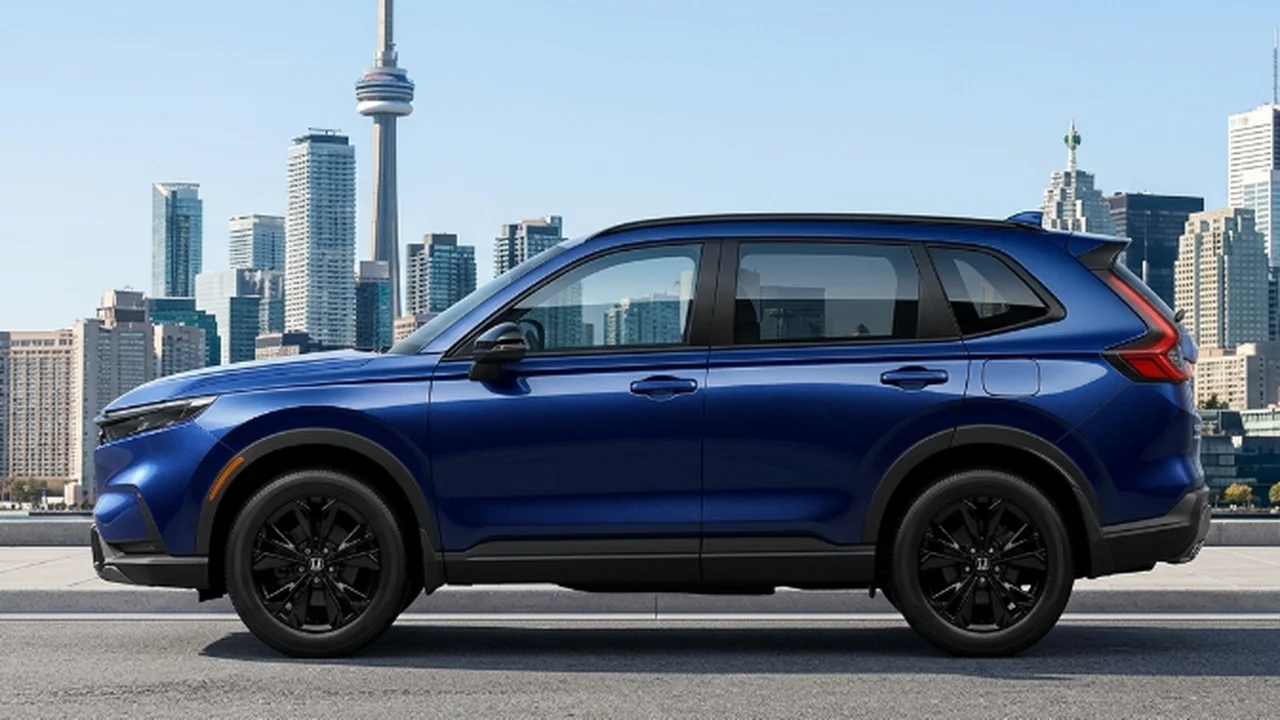
2026 Honda CR-V profile along waterfront promenade — mid-size agility and cabin volume.
Both of these are excellent Honda SUVs. The right one depends on the life you actually live, not the life you imagine twice a year. Below is the honest, owner-grounded breakdown for Vaughan and GTA drivers.
Both are great Hondas — the real question is which one fits
It is the question I get at the lot more than almost any other: HR-V or CR-V? Both are Honda. Both are compact SUVs. Both come with Real Time AWD on most trims. And both are vehicles I recommend without hesitation to the right buyer. The trouble is that "great" is doing a lot of work in that sentence, because the HR-V and the CR-V are not the same vehicle wearing two badges. They answer two different daily lives.
Across Reddit, the same owners keep landing on the same conclusion — and it is almost always the right one. People who bought the HR-V and never looked back usually say the smaller SUV was exactly enough car for their week. People who tried to make the HR-V work as a family hauler almost always wish they had taken the CR-V. The mistake is rarely the brand or the dealer. The mistake is choosing the size for the imagined life instead of the actual one.
Quick answer:
• If your week is mostly one or two adults, groceries, gym bags, and a commute — start at the HR-V. You will not feel shortchanged.
• If you regularly carry two rear-facing child seats, a stroller plus dog crate, hockey gear for three, or weekly cottage packing — start at the CR-V. You will use the room every week.
What owners actually love about the HR-V
When you sort through the threads on r/HRV and r/Honda, a clear picture emerges of who the HR-V is built for and why owners stay happy.
The phrase that comes up again and again is "right size." From first-time SUV buyers moving up from a Civic, from couples without kids, from empty nesters downsizing from a CR-V, from people who live in condos with tight parking — the HR-V gets called the happy medium between too small and too big. One owner put it as "the CRV is definitely a 'better' vehicle, but I have zero regrets getting my HR-V."
Owners consistently praise five things:
- The way it drives around town. "I like how nimble it is and how easy it is to park. I like how simple it is — it just drives well and isn't too complicated in the engine bay."
- How easy it is to live with day to day. "It just sits higher up and has more features even with the LX base model."
- Real-world fuel economy that beats the brochure. Multiple Canadian owners report 7.8–8.5 L/100 km combined in mixed driving, which is below the 8.7 L/100 km AWD official rating. ECON mode helps.
- The look and feel. "I love the look of the HR-V, the red is absolutely fantastic. The seats are comfortable, the speakers are miles better than the stock system."
- Long-term durability. Owners at 100,000+ km routinely report zero major issues when maintenance has been kept up. The 2.0L naturally aspirated engine is widely regarded as one of the most reliable in the modern Honda lineup.
And on the quieter note that matters to most Vaughan buyers: the HR-V is genuinely easier to place. It is 127 mm shorter than the CR-V, noticeably easier to maneuver in older condo parking, and it does not feel like a big SUV when you are merging into a short on-ramp pocket or backing into a tight driveway. That is not a small thing when you live with the car every day.
What owners actually love about the CR-V
The CR-V has been Canada's best-selling SUV for years, and reading the owner threads on r/CRV tells you exactly why.
Three things come up over and over:
- It feels like a more substantial vehicle without being a big one. "It's an incredible vehicle and very quiet to drive. Fuel economy has been strong and the car has good power. The Bose sound system is incredible."
- The hybrid powertrain wins people over fast. Multiple owners who cross-shopped the gas CR-V and the CR-V Hybrid say the hybrid is the one they would buy again. Phrases that come up: smoother, quieter, better in stop-and-go, and fuel cost that genuinely shows up in the monthly budget — several owners describe a meaningful fuel-economy jump after switching to a CR-V Hybrid from a gas vehicle.
- It is the right size for a real family without crossing into three-row territory. "Spacious, comfy, smooth ride, good acceleration and sips gas. I prefer to keep my cars through high miles and plan to keep this one a long time."
The CR-V Hybrid also comes with the most reassuring warranty story in the lineup: 8 years or 160,000 km of hybrid system coverage from Honda Canada, on top of the standard 3-year / 60,000 km new-vehicle warranty and 5-year / 100,000 km powertrain warranty. For a buyer planning to keep the vehicle past the lease, that is real long-term peace of mind.
The honest size comparison
Here is what Honda Canada's official 2026 model-year specifications actually say, side by side. These come straight from the Honda Canada Newsroom release of August 6, 2025.
| Spec | Honda Canada official (2026 model year) |
|---|---|
| Length | 4,568 mm (HR-V) / 4,695 mm (CR-V) — CR-V is 127 mm longer |
| Width | 1,840 mm (HR-V) / 2,150 mm (CR-V, mirrors folded) |
| Height | 1,620 mm (HR-V) / 1,680–1,690 mm (CR-V) |
| Wheelbase | 2,655 mm (HR-V) / 2,700–2,701 mm (CR-V) — CR-V has 45–46 mm more |
| Ground clearance | 177.8 mm FWD / 185.4 mm AWD (HR-V) / 198 mm FWD / 208 mm AWD (CR-V) — CR-V AWD sits ~23 mm higher |
| Cargo behind rear seats | 691 L (HR-V) / 1,113 L gas CR-V, 1,028 L hybrid CR-V — CR-V has 337–422 L more |
| Cargo with rear seats folded | 1,559 L (HR-V) / 2,166 L gas CR-V, 2,030 L hybrid CR-V — CR-V has 471–607 L more |
| Rear legroom | 958 mm (HR-V) / 1,042 mm (CR-V) — CR-V has 84 mm more rear knee room |
| Curb weight | 1,441–1,516 kg (HR-V) / 1,583–1,785 kg (CR-V) — CR-V is roughly 140–270 kg heavier |
| Towing capacity | Not rated for towing (HR-V) / Up to 680 kg gas, 453 kg hybrid (CR-V) |
Two things stand out. First, the CR-V's cargo advantage is not small — roughly 60 percent more room behind the rear seats in the gas model. Second, the rear-seat legroom gap (84 mm) is meaningful for anyone fitting two child seats plus a passenger, or for adult passengers on a 401 / QEW run. The HR-V is not a penalty box in the back seat, but the CR-V is genuinely comfortable for three across on a long drive.
Power, drivetrain, and what "underpowered" actually means
Honda Canada offers one engine in the HR-V and two in the CR-V. Both vehicles run a continuously variable transmission in every trim.
| Spec | Honda Canada official (2026 model year) |
|---|---|
| HR-V engine | 2.0L port-injection 4-cylinder, 158 hp @ 6,500 rpm, 138 lb-ft @ 4,200 rpm |
| CR-V gas engine | 1.5L turbocharged 4-cylinder, 190 hp @ 6,000 rpm, 179 lb-ft @ 1,700–5,000 rpm |
| CR-V hybrid powertrain | 2.0L Atkinson 4-cylinder + 2 electric motors, combined 204 hp, 247 lb-ft, eCVT |
| Drive modes (HR-V) | ECON, Normal, Snow |
| Drive modes (CR-V gas) | ECON, Normal, Snow |
| Drive modes (CR-V hybrid) | ECON, Normal, Sport, Snow — Sport is exclusive to hybrid trims |
| Real Time AWD availability | Optional on HR-V LX, standard Sport and EX-L / Standard on most CR-V trims |
The HR-V's 158 hp is honest. Around town, in traffic, and at GTA speeds it is fine. Owners sometimes call out two specific situations: merging onto a 400-series highway at rush hour with a full load, and passing at highway speed in the 110–130 km/h range. Neither is a daily event for most buyers, but if either is your daily event, the CR-V turbo or hybrid is the calmer tool for the job.
The CR-V Hybrid is the most interesting version. With 204 combined horsepower and 247 lb-ft of torque from a standstill, it is the quickest CR-V Honda makes. It is also the most fuel-efficient CR-V by a wide margin. The hybrid powertrain also adds a Sport drive mode the gas CR-V does not have.
Fuel economy and real-world Ontario driving
Honda Canada's official ratings, in L/100 km, city / highway / combined:
| Spec | Honda Canada official (2026 model year) |
|---|---|
| HR-V FWD | 9.1 / 7.4 / 8.3 |
| HR-V Real Time AWD | 9.5 / 7.8 / 8.7 |
| CR-V LX FWD (gas) | 8.4 / 7.1 / 7.8 |
| CR-V Sport AWD (gas) | 9.1 / 7.6 / 8.4 |
| CR-V Sport Hybrid AWD | 6.0 / 6.9 / 6.4 |
| CR-V TrailSport Hybrid AWD | 6.3 / 7.2 / 6.7 |
| CR-V EX-L Hybrid AWD | 6.0 / 6.9 / 6.4 |
| CR-V Touring Hybrid AWD | 6.0 / 6.9 / 6.4 |
| Fuel tank (both vehicles) | 53 L — same on every HR-V and CR-V trim |
A few things Ontario drivers should notice. The HR-V AWD at 8.7 L/100 km combined and the CR-V gas AWD at 8.4 L/100 km combined are nearly identical — the bigger engine in the bigger vehicle barely shows on the consumption sheet, because the smaller engine in the HR-V is working harder. Where the CR-V Hybrid pulls away is city and mixed driving: 6.0–6.3 L/100 km city versus 9.1–9.5 L/100 km for the gas AWD models. At realistic GTA fuel prices, that is a real-money difference over a year of commuting.
Real-world note from Canadian owners: in normal mixed driving, many Honda HR-V AWD owners report 7.8–8.5 L/100 km combined, which actually beats the 8.7 L/100 km official rating. The CR-V Hybrid is rated to deliver the same kind of under-rating performance in city driving. In deep Ontario winter (below -15 °C), short-trip fuel economy on any of these vehicles climbs 1–2 L/100 km for the first few kilometres while the engine and hybrid battery warm up. Plan for that on the commute, not the brochure.
Trims, features, and the "fully loaded HR-V vs base CR-V" question
Honda Canada's 2026 lineup:
- HR-V comes in three trims: LX (FWD or AWD), Sport (AWD), and EX-L (AWD). All three include Honda Sensing as standard. The EX-L adds leather, 8-way power driver seat, and the larger wheel.
- CR-V comes in six trims: LX (FWD or AWD), Sport (gas AWD), Sport Hybrid, TrailSport Hybrid, EX-L Hybrid, and Touring Hybrid. New for 2026 is the LX 2WD and the TrailSport Hybrid, which adds factory all-terrain tires and a small ride-height bump over the Sport Hybrid.
- Honda Sensing is standard on every HR-V and CR-V trim. Blind Spot Information and Cross Traffic Monitor are standard across both lineups. The CR-V Touring Hybrid adds Low-Speed Braking Control and front and rear parking sensors.
This is where the "fully loaded HR-V versus base CR-V" debate actually resolves. The HR-V EX-L is feature-complete for most buyers: leather, heated seats and steering wheel, 9-inch touchscreen, wireless CarPlay and Android Auto, and the full Honda Sensing suite. For a household that genuinely fits in the HR-V, the EX-L is the right answer.
But the moment you start wishing for more rear-seat room, more cargo, a hybrid, or towing for a small utility trailer, the math flips. The CR-V LX AWD at base price already matches the HR-V EX-L on safety tech and Honda Sensing, and adds 422 L of cargo behind the rear seats. The CR-V Sport Hybrid AWD is where the lineup starts paying you back in fuel if your commute is city-heavy. Pricing changes monthly with Honda Canada's programs, so get a current quote before deciding.
What this means for Ontario driving
Three Ontario-specific notes worth weighing:
- Winter confidence: both vehicles are available with Real Time AWD and both come with all-season M+S tires from the factory. Neither replaces real winter tires in Vaughan, Barrie, or anywhere the 400-series gets ugly in January. The CR-V AWD sits about 23 mm higher than the HR-V AWD, which helps in deeper snow but is not a deciding factor on its own.
- Parking and storage: the HR-V is 127 mm shorter and noticeably easier to place in older condo parking and tight driveways. If you live in a tower with narrow stalls, that gap shows up every day.
- Highway driving: the CR-V turbo and CR-V Hybrid both have noticeably more passing power at 100–120 km/h than the HR-V. If your commute includes a 400-series on-ramp or you regularly tow a small utility trailer or jetskis, the CR-V is the calmer answer.
Why both vehicles earn their place in the lineup
It is worth saying out loud: this is not a "which one is better" article because neither vehicle is better than the other. It is a "which one is better for you" article. Honda sells both because both are genuinely good.
The HR-V is a compact SUV that does not feel like a compromise. Owners consistently report real-world fuel economy that beats the rating, mechanical simplicity that holds up past 100,000 km, and a size that fits more Ontario lives than people expect. For one or two adults whose week is mostly commuting, errands, and a passenger or two, it is more vehicle than they need in the best possible way.
The CR-V is a compact SUV that feels like an upgrade in every direction — more cargo, more rear-seat room, more powertrain options, more towing capability. It is also the most fuel-efficient CR-V Honda has ever made, in hybrid form. For a real family or anyone who regularly uses the back seat and the cargo area, the CR-V is the smarter long-term buy.
Both vehicles share the same Honda DNA: Honda Sensing standard across the lineup, strong resale value in the Canadian market, and a maintenance record that explains why they keep showing up at 150,000 km and beyond.
Myth check: a few things worth correcting
Things owners get wrong, in my experience at the desk:
- Myth — "The HR-V is just a smaller CR-V, they are basically the same vehicle." They share a platform family but the dimensions, powertrains, and trim strategies are different. Treat them as two distinct SUVs, not one SUV in two sizes.
- Myth — "The HR-V is too small for a family." For a family of three or four with younger children, the HR-V works day-to-day. The CR-V becomes the better answer when you need two rear-facing child seats plus a passenger, or a full-size dog crate plus luggage, on a regular basis.
- Myth — "The CR-V is always more expensive to run." Not in fuel. The CR-V gas AWD and HR-V AWD are within 0.3 L/100 km of each other combined. The CR-V Hybrid actually costs less to fuel than the HR-V AWD by roughly 25 percent in city driving.
- Myth — "You do not need AWD in Ontario." Real Time AWD is not four-wheel drive and it does not turn a FWD vehicle into a snow truck. What it does is help with traction off the line and through slippery intersections. Real winter tires do more for winter safety than AWD ever will.
When to book a test drive, and what to bring
If you are at the choosing stage, a 20-minute back-to-back test drive of the HR-V and the CR-V in the same afternoon is worth more than a week of spec-sheet reading. Bring the gear you actually carry. If you usually have a stroller in the trunk, bring it. If you cart hockey bags, bring one. Open the tailgate, fold the seats, sit in the back with a child seat if that is your life. Ten minutes of that tells you more than any comparison article.
A few questions worth asking at the desk:
- What is the current Honda Canada finance and lease rate on each trim, with the realistic payment for your term and kilometres?
- What is the realistic 5-year resale on the specific trim you are considering, based on Canadian auction data?
- For the CR-V Hybrid, what is the high-voltage battery warranty and what does it cover? (Honda Canada's hybrid system warranty is 8 years or 160,000 km, whichever comes first — ask your dealer to confirm the current terms.)
- If you plan to add accessories (hitch, cargo tray, all-weather mats), get them priced into the deal on day one. It is almost always cheaper than buying them later.
If you want help working through the size, powertrain, and trim decision in one sitting, reach out. I would rather spend 30 minutes putting you in the right vehicle than hand you keys to the wrong one.
Frequently asked, Vaughan edition
Is the Honda HR-V big enough for most Vaughan drivers?
Usually, yes. If your week is mostly commuting, groceries, gym bags, occasional IKEA runs, and one or two passengers in the back, the HR-V covers that life well. It is the buyers who regularly carry a full family, a stroller plus dog crate, or cottage-trip gear who should move up to a CR-V.
What is the biggest advantage of the HR-V over the CR-V?
Size. The HR-V is easier to park, easier to place in tight garages, and generally feels less bulky in daily GTA driving while still giving you SUV ride height and available AWD. The 2026 HR-V is roughly 4,568 mm long versus 4,695 mm for the CR-V. For many buyers, that is the real win.
When should I skip the HR-V and buy a CR-V instead?
Skip straight to the CR-V if you know you need more rear-seat and cargo flexibility every week, not once in a while. Two rear-facing child seats, a larger dog crate, a full-size stroller, or frequent cottage packing are the situations that usually justify the bigger step. The CR-V Hybrid is the right pick if your commute is city-heavy and you want the fuel savings to show up in your monthly budget.
Does the HR-V still make sense if I want AWD?
Yes. Honda offers available Real Time AWD on the HR-V LX, and standard AWD on Sport and EX-L, so you do not have to jump to a CR-V just because you want extra winter confidence in Vaughan.
Which CR-V trim should I look at first?
For most buyers, the CR-V Sport Hybrid AWD is the smartest starting point. You get the hybrid powertrain, the eCVT smoothness, Real Time AWD, and a mid-line price. The EX-L Hybrid adds leather, a larger driver display, and a power tailgate. The Touring Hybrid adds the BOSE audio system, Google built-in, and rain-sensing wipers. The new TrailSport Hybrid is purpose-built for unpaved cottage lanes and ski chalet driveways with factory all-terrain tires.
Will the HR-V or CR-V hold its resale value better?
Historically the CR-V has held resale better, partly because it has been on sale in Canada far longer and in much higher volume. The HR-V resale gap has narrowed since the 2023 redesign but the CR-V still leads in absolute dollars. Both are well ahead of the segment average.
Fact-check notes (sources and dates checked)
All figures in this article were checked against primary sources on 2026-06-19. Pricing and incentive programs change monthly with Honda Canada — those figures are not in this article because they would date it within weeks.
- Honda Canada Newsroom — 2026 Honda HR-V Specifications, release dated 2025-08-06. Source for HR-V engine, dimensions, cargo, fuel economy, AWD availability, trim details. EN-CA release ID release-ac33504a222e00b87434e7b393009f07.
- Honda Canada Newsroom — 2026 Honda CR-V Specifications, release dated 2025-08-06. Source for CR-V engine, dimensions, cargo, fuel economy, AWD availability, trim details. EN-CA release ID release-ac33504a222e00b87434e7b393009afc.
- Honda Canada product pages — honda.ca/en/hrv (current model year) and honda.ca/en/crv (2026 model year). Used for trim lineup, feature availability, and current pricing.
- Honda Canada standard warranty page — honda.ca/en/honda-plus/standard-warranty. Source for the 8 years / 160,000 km hybrid system warranty and standard 3 years / 60,000 km new-vehicle warranty.
- Owner sentiment references (Reddit threads, 2024–2026) — r/Honda, r/HRV, r/CRV, r/whatcarshouldIbuy, r/MechanicAdvice. Threads consulted include repeated comparison posts, owner long-term reviews, fuel economy threads, and regret-vs-no-regret threads. No individual usernames or identifiable details are quoted; only repeated patterns across multiple threads are cited, paraphrased in plain language.
- fuel consumption ratings (oee.nrcan.gc.ca) — tool accessed 2026-06-19. Honda Canada's own published ratings were used directly because the honda.ca tool requires JavaScript interaction that did not return data in this session. Honda Canada ratings are the manufacturer-submitted values that honda.ca publishes.
- Winter tire and AWD guidance reflects general Ontario / Canadian winter driving practice, not a specific regulatory citation. Always confirm current requirements with your insurer and the relevant provincial authority.
Items not included in this article by design: current MSRP (changes monthly with Honda Canada programs), specific lease and finance rates, current Honda Financial Services incentives, dealer-installed accessory pricing, and provincial / municipal fee schedules. Get these in writing from your dealer before signing.
Want help working through it?
If you are between the HR-V and CR-V and want a real back-to-back test drive with your actual gear in the cargo area, send a text or call and I will set it up.
Ask Henry a question
Not ready to book anything? Just ask. Henry Chen answers every message himself — usually within a couple of hours during business hours. No call list, no pressure, and no obligation to buy anything.