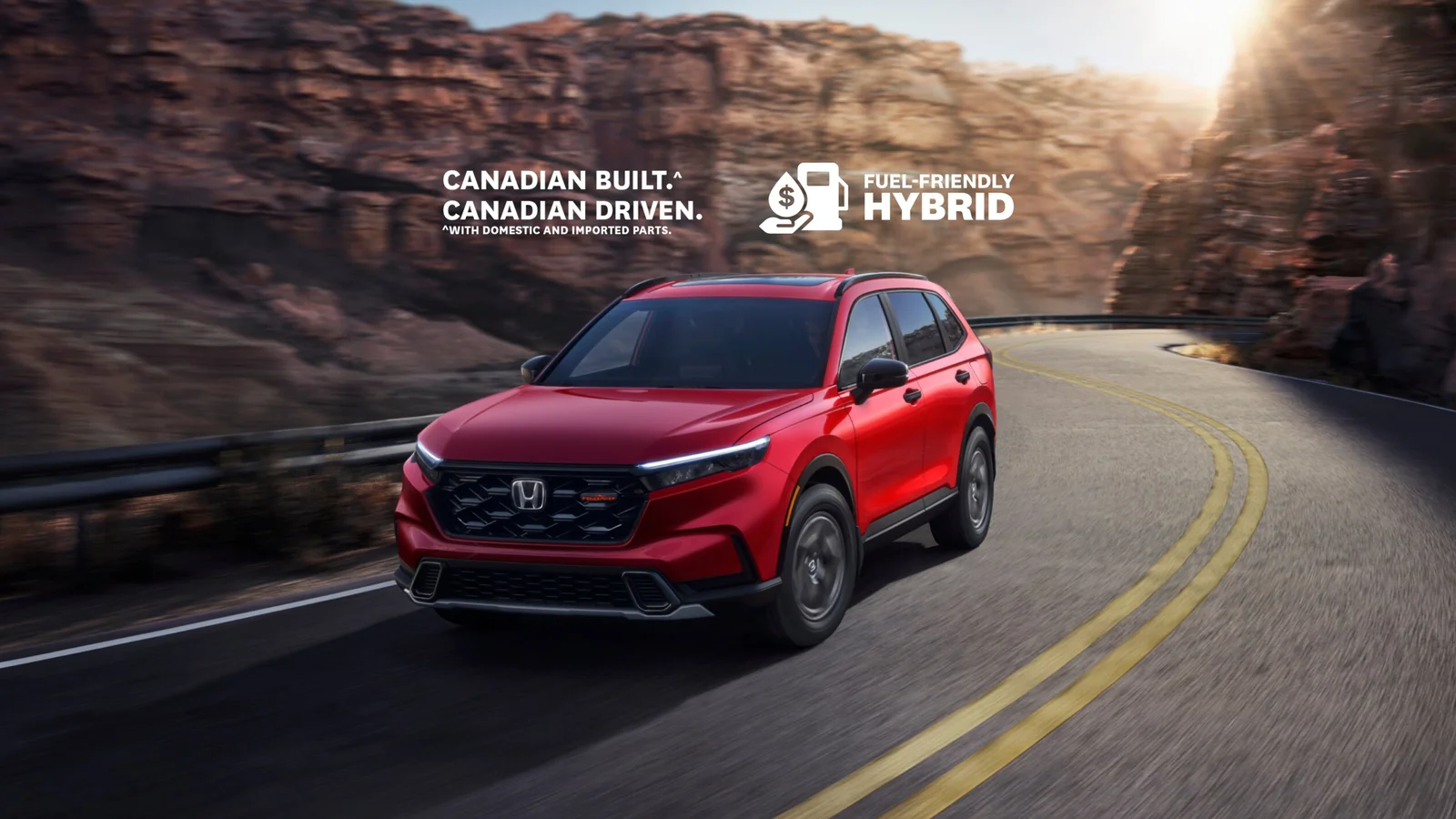
Photo: Honda Canada. 2027 Honda CR-V front styling heading Honda Canada's electrified SUV lineup.
Honda’s hybrid roadmap matters because it changes the way Canadian buyers should think about timing. It does not mean every buyer should wait. It means hybrids are moving from “alternative powertrain” to core product strategy, especially in North America.
The official Honda Global briefing gives us the framework: next-generation hybrid models begin launching in 2027, Honda plans 15 next-generation hybrid models globally by FY2030, North America is a priority region, and large-size hybrid models in the D-segment or above are planned for North America in 2029.
Source: Honda Canada Newsroom — Summary of 2026 Honda Business Briefing (May 14, 2026).
The four facts that matter most
- Honda is reallocating more development and production resources into hybrid models because demand is high.
- Next-generation hybrid models start launching in 2027.
- Honda is targeting more than 30% lower cost for the next-generation hybrid system versus the system introduced in 2023.
- Honda is targeting more than 10% better fuel economy when the new hybrid system is combined with the next-generation platform and newly developed electric AWD unit.
What it means by model
| Model family | Current buyer meaning | Future-roadmap meaning |
|---|---|---|
| Civic | Current Civic Hybrid is already a strong commuter choice with up to 200 hp and 232 lb.-ft. | Future Civic speculation is interesting, but Canadian details are not confirmed. Buy-now vs wait depends on your deadline. |
| CR-V | CR-V Hybrid already creates clear fuel savings against gas AWD in official Canadian fuel numbers. | Next-gen hybrid cost reductions could eventually narrow the hybrid premium, but current buyers should still price today’s programs. |
| Accord | Accord Hybrid remains the logical midsize sedan option for drivers who want comfort and fuel economy. | The Honda Hybrid Sedan Prototype makes sedan buyers worth watching from 2027 onward. |
| Pilot / Passport / Odyssey class | Current family-size Honda shoppers should buy on actual inventory and family deadline. | Large-size North American hybrids are tied to 2029 in Honda’s roadmap, not immediate 2026-2027 inventory. |
| Prologue / EV shoppers | Prologue is Honda Canada’s current EV route in select provinces and dealers. | Honda’s near-term Canadian showroom logic is still hybrid-first while EV strategy resets. |
CR-V Hybrid fuel math Canadians can understand
The CR-V is the cleanest example because Honda Canada publishes comparable fuel numbers. Gas AWD CR-V models consume as little as 8.4 L/100 km, while CR-V Hybrid AWD models consume as little as 6.4 L/100 km. That is a 2.0 L/100 km difference before we even discuss driving feel, resale, or trim equipment.
| Annual driving | Gas saved at 2.0 L/100 km difference | Approx. savings at $1.60/L |
|---|---|---|
| 20,000 km/year | 400 litres/year | $640/year |
| 25,000 km/year | 500 litres/year | $800/year |
| 30,000 km/year | 600 litres/year | $960/year |
This is why hybrid conversations should be personalized. A buyer who drives 8,000 km per year and keeps a car for two years is not the same as a buyer who drives 30,000 km per year and keeps a car for eight years. The higher the mileage, the more the hybrid argument moves from “green choice” to “financially obvious choice.”
What the 30% cost reduction really means
The 30% number is not a promise that buyers will pay 30% less for a future hybrid vehicle. It is Honda’s target to reduce the cost of the next-generation hybrid system compared with the system introduced in 2023. That matters because lower manufacturing cost can eventually help price, mix, availability, or margin. But buyers should not translate it into a specific discount until Honda Canada publishes actual prices and programs.
This distinction is a trust opportunity. Many sites will turn “30% cost reduction” into a flashy consumer-price headline. Henry should not. The stronger angle is: lower system cost improves the long-term business case for hybrids, but today’s payment still depends on the vehicle, trim, rate, residual, incentive, trade, and down payment.
Canadian EV context: the indefinite Canada EV value-chain suspension
On the same day as the May 14 Business Briefing, Honda also announced it will indefinitely suspend the project to build a comprehensive EV value chain in Canada and continue to reassess its procurement strategy. That does not change what is on Honda Canada’s showroom floor today — the Prologue remains the current Honda EV in select provinces and dealers — but it does explain why Honda’s near-term Canadian showroom logic is hybrid-first.
The buyer decision: buy now, wait, or lease strategically
| Decision path | Best for | Risk |
|---|---|---|
| Buy current hybrid now | Drivers with a near-term need and high annual mileage | Possible future tech arrives later, but current fuel savings start immediately. |
| Wait for next-gen hybrid | Drivers with reliable current cars and flexible timelines | Canadian specs, price, and allocation are unknown. |
| Lease current model | Buyers who want flexibility before 2028-2029 product changes | Lease terms must be structured carefully around mileage and end date. |
| Buy gas now | Low-mileage drivers or payment-sensitive buyers | Fuel savings and resale gap may favour hybrid over time. |
Bottom line
Honda’s hybrid roadmap is a real strategic shift, but the smartest shopper does not wait automatically. The right move is to match Honda’s product timing against your personal deadline. If you drive a lot, run the hybrid math now. If you can wait until 2027-2030, track the next-generation rollout. If you need a vehicle this year, make the decision with today’s real payment and fuel cost, not a future headline.
FAQ
When do Honda next-generation hybrids start arriving?
Honda says next-generation hybrid models begin launching in 2027, with 15 next-generation hybrid models planned globally by FY2030, primarily in North America.
Does the 30% cost reduction mean 30% cheaper vehicles?
No. It refers to Honda’s target for reducing the hybrid system cost compared with the system introduced in 2023. Consumer pricing will depend on many factors.
Should CR-V buyers choose hybrid?
Many should at least compare it seriously. Honda Canada lists gas AWD CR-V fuel consumption as low as 8.4 L/100 km and CR-V Hybrid AWD as low as 6.4 L/100 km. The annual savings can be significant for higher-mileage drivers.
Need the numbers on a real Honda?
I can compare lease, finance, trade-in, and timing options before you commit to the wrong move. Quick text or call is enough to start the conversation.
Ask Henry a question
Not ready to book anything? Just ask. Henry Chen answers every message himself — usually within a couple of hours during business hours. No call list, no pressure, and no obligation to buy anything.