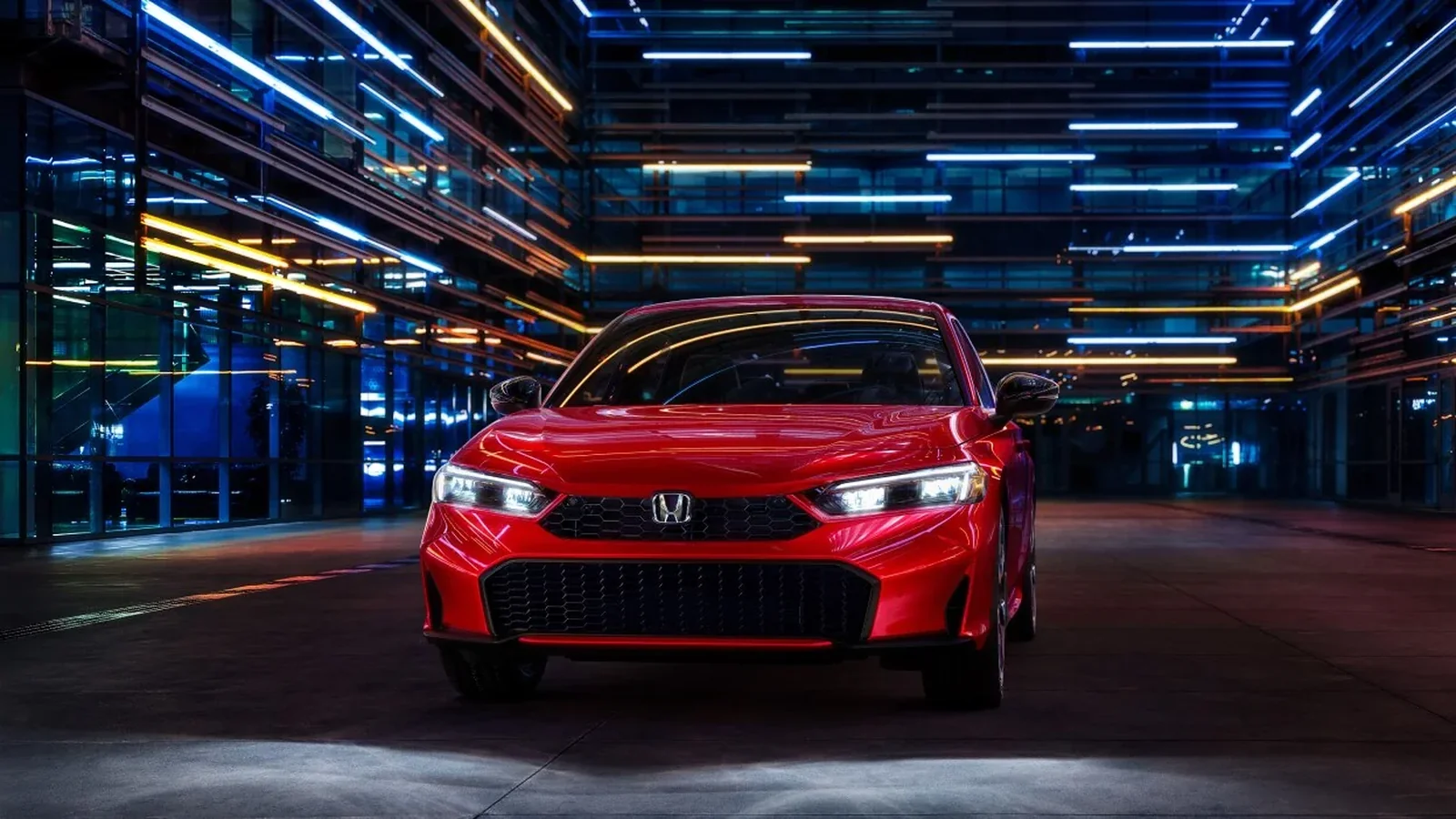
Photo: Honda Canada. 2026 Honda Civic Sedan exterior styling.
I work with empty-nester buyers every month. Some are going from Pilot to Civic — a 3-row SUV to a compact sedan is the most extreme downsizing direction and works for a lot of couples. Some are going from Pilot to CR-V — keeping SUV practicality but losing the third row. Some are going from Pilot to Accord — the sedan-with-character option.
This page is the version Henry gives to his downsizing clients at Maple Honda. It assumes you’re a 2-adult household now, possibly with visiting grandkids, possibly with active retirement travel plans, and possibly with a Costco habit.
Why downsizing usually makes sense
The math:
- Insurance drops $80–$180/month going from Pilot to Civic. The Pilot is in the 3-row SUV insurance bracket; the Civic is the compact sedan bracket. That’s ≃C$1,000–$2,200/year in your pocket.
- Fuel drops $80–$150/month going from Pilot (11.0 L/100 km combined per honda.ca) to Civic Hybrid (4.9 L/100 km combined per honda.ca). At 15,000 km/year, that’s ≃C$1,400–$1,800/year in your pocket.
- Maintenance is lower on Civic vs Pilot. Tires are smaller and cheaper (Civic: ~$200/tire vs Pilot: ~$350/tire). Brakes are smaller. Oil changes are the same price. The lifetime maintenance delta is real but smaller — maybe $300–$500/year.
- Parking is easier — the Civic fits in any GTA parking spot. The Pilot is too long for some downtown Toronto garage spaces.
- Driving is easier — the Civic is more manoeuvrable in any GTA traffic. Less stressful on the 400-series commute.
The total annual savings of downsizing from Pilot to Civic Hybrid: ≃C$3,000–$4,500/year. Over 5 years of ownership, that’s ≃C$15,000–$22,500 — enough to fund a year of retirement travel or a significant upgrade to the Civic trim.
My honest take: the empty-nester move to Civic is the cleanest financial optimization in the Honda lineup. The Pilot isn’t a bad vehicle — it’s just a vehicle that no longer matches the daily life.
Trade-in math — what your Pilot is actually worth
Trade-in value depends on year, mileage, trim, condition, and the current used-Honda market. Rough Canadian-dollar ranges for a 2019–2023 Pilot traded into an Ontario Honda dealer in 2026:
2019 Pilot LX (base 7-seat): ≃C$22,000–$28,000 trade-in for under 100,000 km, clean Carfax, no accidents. ≃C$18,000–$24,000 for 100,000–150,000 km.
2021 Pilot EX-L Navi (mid-trim 7-seat): ≃C$28,000–$35,000 trade-in for under 80,000 km. ≃C$22,000–$28,000 for 80,000–120,000 km.
2022 Pilot Touring (top 7-seat): ≃C$34,000–$42,000 trade-in for under 60,000 km. ≃C$28,000–$34,000 for 60,000–100,000 km.
2023 Pilot TrailSport (off-road 7-seat): ≃C$38,000–$45,000 trade-in for under 60,000 km. TrailSport holds value best because of off-road demand.
For private sale (vs dealer trade-in): add roughly 8–15% to those numbers. Private sale = more money but more work (UVIP, OMVIC exemption, payment fraud risk, no implied warranty if the buyer has issues).
The equity math: if you owe $20,000 on the Pilot and the trade-in value is $32,000, you have $12,000 of equity. That equity becomes the down payment on the Civic. A ≃C$30,000 Civic Hybrid financed with $12,000 down means a smaller loan and a much smaller monthly payment.
If you owe more than the Pilot is worth: you have negative equity. The Pilot loan can’t be rolled into a Civic loan at most lenders (Honda Financial Services doesn’t allow it). You either pay the difference out of pocket or wait until the loan pay-off is closer to the trade-in value.
The downsizing decision tree
Downsizing to Civic if:
- You’re 2 adults, no kids at home, no car seats to install.
- Your weekly driving is mostly city + commuter + Costco + the occasional road trip.
- You don’t tow anything.
- You want the lowest monthly cost and the easiest GTA parking.
- You’re OK with sedan ride height (not SUV).
Downsizing to Accord if:
- You want sedan practicality but more rear-seat room than Civic (for visiting grandkids).
- You do highway commuting and want the most comfortable Honda sedan.
- You want Honda’s most refined sedan driving experience.
Downsizing to CR-V if:
- You want SUV practicality without the 3rd row.
- You occasionally need to carry large items (garden supplies, Costco furniture, ski equipment).
- You want the higher ride height for winter confidence.
- You want available Real Time AWD without going to a Pilot size.
Downsizing to HR-V if:
- You want SUV practicality but at a smaller size than CR-V.
- You want Honda Magic Seat rear configuration (cargo flexibility).
- Your household is 1–2 adults with minimal cargo.
Don’t downsize to:
- Fit (discontinued after 2020). Used Fit inventory is fine but new is gone.
- Pilot, Passport, or Odyssey — that’s not downsizing, that’s staying in the same class.
- Prologue (EV). For most empty-nesters doing mixed city + highway driving, the Civic Hybrid is the cleaner choice. Prologue is for buyers specifically committed to EV.
What changes when you downsize — the specifics
Trunk space: Civic Sedan has 419 L of trunk space per honda.ca. Pilot has roughly 634 L behind the 3rd row, much more behind the 2nd row. Going from Pilot to Civic, you lose the vertical cargo height — a Costco run is fine (419 L handles a flat of drinks + a few bags), but a Costco furniture run may need a different car for that day. Many empty-nesters pair a Civic with a Home Depot rental or a pickup-truck Home Depot rental for the occasional big-item trip.
Passenger space: Civic Sedan has 5 seats with comfortable front and rear space for 2 adults. Pilot has 7 or 8 seats. If visiting grandkids are the use case (occasional car seats in the back), Civic handles 2 car seats + 2 adults. Pilot handles 3 car seats + 3 adults + cargo.
Ride quality: Civic Hybrid rides like a refined compact sedan — quieter at highway speed than the Pilot, more responsive in city traffic. Pilot rides like a 3-row SUV — smoother over rough roads, but bigger and heavier. Most empty-nesters prefer the Civic ride on a daily basis.
Honda Sensing carry-over: the safety suite (ACC, LKAS, CMBS, RDM, BSI, TSR) is standard on every 2026 Civic trim, exactly like it was standard on the Pilot. No downgrade in safety — this is one of the strongest arguments for staying in the Honda family through life changes.
The downsizing transition timeline
Month -2 to month -1 (2 months before the swap):
- Get your Pilot detailed and any minor service done (oil change, cabin air filter, tire rotation if needed).
- Pull the Carfax and the UVIP ($20 from ServiceOntario) so the dealer has clean documentation on trade-in day.
- Start test-driving the Civic Hybrid at multiple Honda dealers in the GTA. The trim choice (LX vs Sport vs Touring) is what you’re deciding in this phase.
Month 0 (the swap month):
- Confirm trade-in value with Henry at Maple Honda — send photos, mileage, and service records ahead of time.
- Negotiate the Civic price separately from the trade-in value. Two conversations, not one.
- Confirm financing terms (HFS loyalty rate applies if your Pilot is financed with HFS).
- Insurance: notify your broker of the new vehicle 5–7 days before pickup so the policy swap is clean.
Month +1 to month +2 (post-swap):
- Notice the monthly cost drop — $150–$300/month lower than the Pilot setup, depending on the Civic trim.
- Notice the parking ease — the Civic fits in spots the Pilot didn’t.
- Notice the fuel savings — first fill-up will be cheaper than expected.
- Notice the ride quality — quieter at highway speed, more responsive in city traffic.
The Civic Hybrid vs Civic gas — empty-nester decision
Civic Hybrid is the default empty-nester pick. 200 hp combined, 4.9 L/100 km combined (per honda.ca). The hybrid system is invisible to drive — just start and go. Insurance is $10–40/month lower than Civic gas because Hybrid drivers have lower claim frequency.
Civic gas is the right pick if:
- You drive less than 10,000 km/year (the hybrid payback is slower at low mileage).
- You have strong feelings against CVTs (the gas Civic has a CVT — the hybrid also has an e-CVT but feels different).
- You want the lowest entry MSRP (gas Civic LX is the cheapest Civic trim).
For most GTA empty-nesters doing 12,000–20,000 km/year, the Civic Hybrid pays back the $3,000–$5,000 hybrid premium in 3–4 years of fuel savings, then continues saving ≃C$500–$700/year after that.
My honest take: the Civic Hybrid Touring is the empty-nester move for 80% of the GTA couples I work with. Premium interior, most refined Civic driving experience, hybrid efficiency. Test-drive it for at least 30 minutes including highway time.
What if you don’t want to downsize all the way
If the Civic feels too small:
- Civic Hatchback — same compact footprint as the Sedan but more cargo height and a hatchback opening for easier loading. 694 L behind rear seats per honda.ca.
- Accord Hybrid — the bigger sedan. More rear-seat room than Civic, similar fuel economy, the most refined sedan Honda makes.
- HR-V — the small SUV. Higher ride height, Magic Seat rear config, available AWD. The smallest SUV in the Honda lineup.
- CR-V Hybrid — the small SUV with hybrid. 6.4 L/100 km combined, Real Time AWD standard, the most versatile Honda for 2 adults with cargo needs.
The downsizing decision doesn’t have to go all the way to Civic Sedan. The point is to right-size the car to the current life, not to chase the smallest possible Honda.
The long-term math
If you’re 60 and you downsize from a 2020 Pilot Touring ($48k new) to a 2026 Civic Hybrid Touring ($36k), the 5-year math is:
Upfront:
- Pilot trade-in value (2020 Touring, ≃C$80k km, clean): ≃C$28,000.
- Civic Hybrid Touring new: ≃C$36,000 + HST.
- Net cash out of pocket: ≃C$11,000 + HST (plus any negative equity if you owe more than $28k on the Pilot).
Monthly:
- Pilot payment was (financed at 5.9% over 60 months, ≃C$48k): ≃C$930/month.
- Civic Hybrid Touring payment (financed at 5.9% over 60 months, ≃C$36k, ≃C$11k down): ≃C$490/month.
- Monthly savings on payment: ≃C$440/month.
Estimate only, OAC (on approved credit). Confirm your exact rate, term, and payment with Henry — rates and residuals change monthly.
Annual:
- Insurance: ≃C$1,500/year savings.
- Fuel: ≃C$1,600/year savings (Pilot 11.0 L/100 km vs Civic Hybrid 4.9 L/100 km at 15,000 km/year).
- Maintenance: ≃C$400/year savings.
- Total annual savings: ≃C$3,400/year + the ≃C$5,280/year payment savings = ≃C$8,680/year total cash flow improvement.
Over 5 years of Civic ownership: ≃C$43,000 in total cash flow improvement. That’s a meaningful retirement number.
Frequently asked questions
Is downsizing from Pilot to Civic a downgrade?
In capability terms — yes, you lose 3-row seating, SUV cargo height, and the higher ride height. In daily-life terms — no, you gain easier GTA parking, lower insurance, lower fuel cost, and a more manoeuvrable city car. For empty-nesters doing 2-adult daily driving, the Civic is the right-size vehicle for the current chapter, not a downgrade. Honda Sensing is standard on every Civic trim — no safety downgrade.
How much is my Honda Pilot worth as a trade-in?
A 2020–2023 Pilot in clean condition with under 100,000 km is worth roughly ≃C$22,000–$45,000 trade-in at an Ontario Honda dealer in 2026, depending on trim and mileage. TrailSport holds value best because of off-road demand. Touring and Black Edition trim levels hold value better than base LX. The most accurate value comes from a 5-minute inspection by Henry — send photos, mileage, and trim and he’ll give you a real number.
Should I get the Civic Hybrid or Civic gas?
For most GTA empty-nesters doing 12,000–20,000 km/year, the Civic Hybrid pays back the ≃C$3,000–$5,000 hybrid premium in 3–4 years of fuel savings and continues saving ≃C$500–$700/year after that. The Hybrid is also quieter, smoother in stop-and-go traffic, and slightly cheaper to insure. Civic gas is the right pick only if you drive very low mileage (under 10,000 km/year) or want the lowest entry MSRP.
What about Honda Sensing on the Civic — is it as good as on the Pilot?
Yes — the safety suite is identical across the Honda lineup. Adaptive cruise control with low-speed follow, lane keeping assist with traffic jam assist, collision mitigation braking, road departure mitigation, blind spot information, traffic sign recognition — all standard on every Civic trim since 2019. The Civic is a smaller vehicle, so the safety features may activate sooner (less mass = shorter stopping distance) but the feature set is the same.
Can I trade in a financed Pilot for a Civic?
Yes — the trade-in value is applied against the Pilot loan pay-off. If the trade-in is higher than the loan pay-off, you have positive equity that becomes the Civic down payment. If the trade-in is lower than the loan pay-off, you have negative equity that you’ll need to pay out of pocket. Honda Financial Services doesn’t allow negative-equity rollover into a new loan in most cases.
What’s the monthly cost difference between Pilot and Civic?
Typical GTA empty-nester setup: Pilot at ≃C$930/month payment + ≃C$280/month insurance + ≃C$200/month fuel = ≃C$1,410/month all-in. Civic Hybrid at ≃C$490/month payment + ≃C$140/month insurance + ≃C$80/month fuel = ≃C$710/month all-in. Monthly savings: ≃C$700/month, or ≃C$8,400/year. Estimate only, OAC (on approved credit); confirm your exact rate and payment with Henry.
Is now a good time to trade in my Pilot?
Used Honda Pilot demand in Ontario is strong in 2026 because Honda stopped producing the previous-generation Pilot (the 2026 Pilot on honda.ca is the new generation with different trim levels). The previous-gen Pilot is in demand as a value pick for growing families. If your Pilot is from 2019–2023, the trade-in value is near peak for that generation. Talk to Henry before assuming the market will stay this strong for another 12–18 months.
What’s the most popular empty-nester Honda right now?
Honda Civic Hybrid at the Touring trim is the most common empty-nester move at Maple Honda in 2026. The Accord Hybrid Touring is the second-most-common — the buyer who wants a sedan but more rear-seat room than the Civic offers. CR-V Hybrid is the third-most-common — the empty-nester who wants SUV practicality without 3-row seating. All three make sense; the choice depends on whether you want sedan or SUV form factor.
Empty nest? Let’s right-size the Honda.
Send Henry what you’re driving now (year, mileage, trim), what your daily life looks like, and the downsizing question you’re working through. I’ll run the trade-in math and walk through the Civic, Accord, CR-V, and HR-V options for the next chapter. Text (647) 523-6878.
Ask Henry a question
Not ready to book anything? Just ask. Henry Chen answers every message himself — usually within a couple of hours during business hours. No call list, no pressure, and no obligation to buy anything.