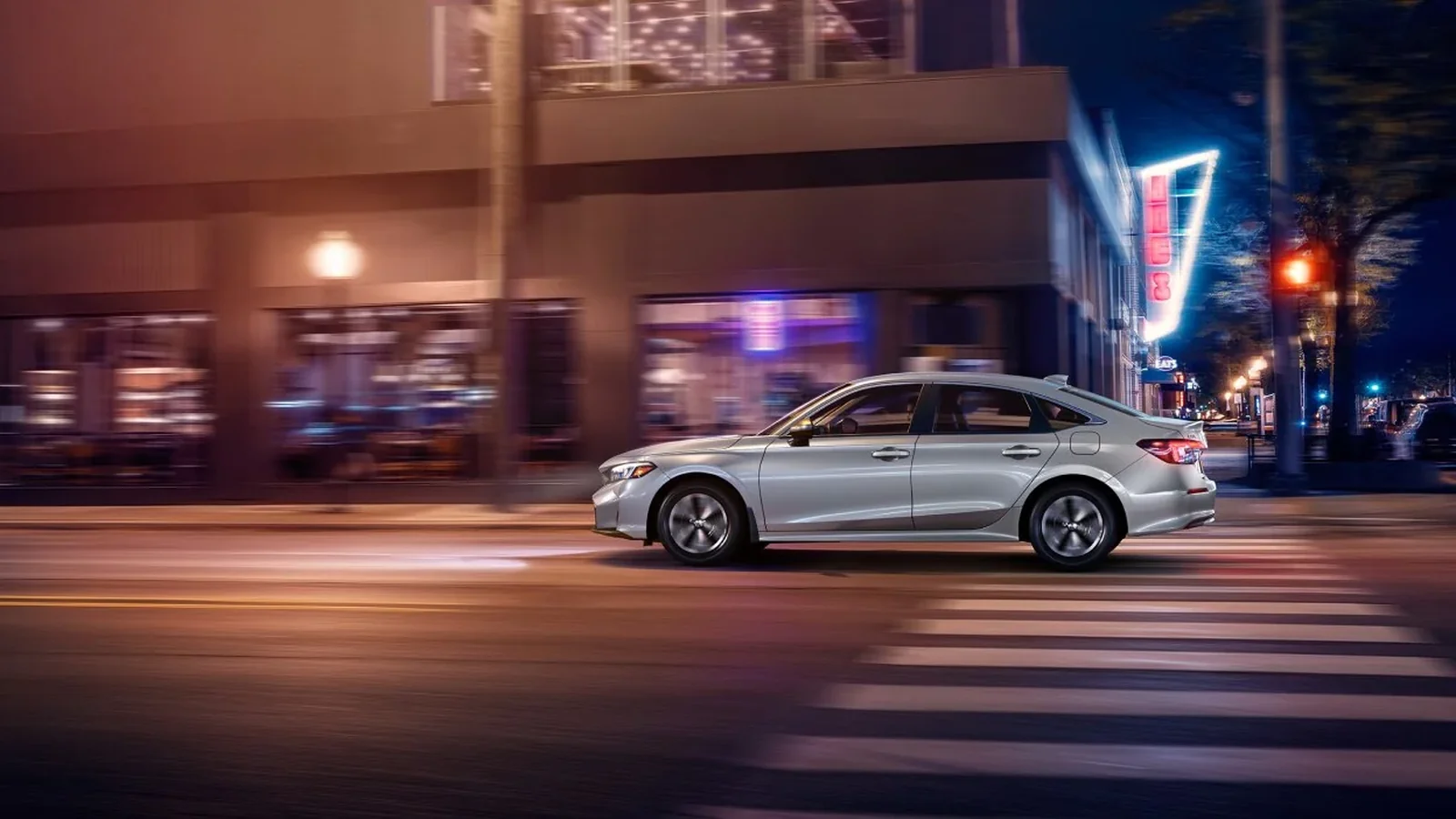
Photo: Honda Canada. 2026 Honda Civic Sedan exterior styling.
I work with this buyer 4–6 times a year. The common thread isn’t the divorce — it’s the re-entry. After years of being the second driver in the household, you’re suddenly the only decision-maker. The technology has changed. The financing process has changed. The dealer experience has changed.
Here’s the orientation — not the Honda model rundown. That comes after.
What’s actually changed since you last bought a car
1. The CVT (continuously variable transmission). Most modern Honda gas cars use a CVT — no shift points, no “gears,” just smooth power delivery. If your last car had a 4 or 5-speed automatic, the CVT will feel weird for the first 10 minutes — the engine stays at one RPM and the car just accelerates. It’s not broken; it’s just different. Test drive for at least 20 minutes before deciding.
2. Hybrid is now widely available across the lineup. In 2026, Honda offers hybrid variants on Civic, Accord, and CR-V, plus the all-electric Prologue. Pilot, Passport, HR-V, Ridgeline, and Odyssey remain gas-only in the Canadian lineup. Where a hybrid option exists, real-world fuel economy is typically 30–50% better than the gas equivalent. The hybrid system is invisible to the driver — just start and go.
3. The infotainment touchscreen is now standard. Apple CarPlay and Android Auto are wireless on most Honda trims since 2024. If your last car had a CD player, this will feel like a spaceship for 2 weeks, then it’ll feel normal. The bigger adjustment is that physical buttons (volume, climate) are mostly gone — it’s all touchscreen now. Some drivers love it. Some don’t. Test the climate controls before signing.
4. Honda Sensing is standard on every 2026 Honda. Adaptive cruise control, lane keeping assist, collision mitigation braking, road departure mitigation, blind spot monitoring. The system is not autopilot — it’s a fatigue-reducer and an emergency backup. If you’ve never used adaptive cruise, it’s the single biggest quality-of-life upgrade in the modern Honda. Test it on the highway during the drive.
5. The financing structure is different. 60-month and 72-month loans are now the standard — 48-month was the norm 20 years ago. Longer terms mean lower monthly payments but higher total interest. The “best” payment is usually at 60 months, not 72. Also: biweekly payments (which most banks default to now) save a month’s interest over the loan term vs monthly.
6. The price transparency is much better. Honda Canada’s MSRP is published, the dealer’s fees are itemized, and the OMVIC all-in-price rule means the advertised price is the actual price (no hidden add-ons). 20 years ago, the dealer could add $2,000 of “protection” fees after you agreed on the price. That practice is now illegal under the MVDA per OMVIC.
What to ignore (or take with a grain of salt)
The extended warranty pitch. Honda Plus extended warranty is real and useful (covers mechanical failures after the factory warranty expires). But you don’t need to buy it the day you sign. You can add Honda Plus for up to 4 years / 100,000 km from the original delivery date per owners.honda.ca. The “buy it today or lose the chance” pressure from F&I is not the full story.
The GAP insurance pitch. GAP insurance pays the difference between what you owe and what the car is worth if it’s totalled. For a Civic or HR-V with a low loan-to-value ratio, GAP insurance is rarely worth it. For a Pilot or Odyssey financed at 90%+ loan-to-value, GAP insurance makes more sense. Ask for the actual numbers — don’t take “everyone needs this” as the answer.
The “$0 down” lease pitch. $0-down leases exist but they’re rarely the best deal. The monthly payment on a $0-down lease is higher than the same car with $3,000–$5,000 down because the residual value is the same — you’re financing more of the depreciation. A small down payment plus the first month’s payment up front usually saves $30–60/month over the lease term.
The trim-level upsell. Honda trims go LX → EX → Sport → EX-L → Touring (or TrailSport / Black Edition on some models). The mid-trim (EX or Sport) is the value pick for most buyers — it has Honda Sensing standard, Apple CarPlay, alloy wheels, and the right feature mix. The top trims add features you may not use (panoramic moonroof, ventilated seats, premium audio). Test the trim you can afford — don’t fall in love with the top trim and finance a stretch budget.
Which Honda for the fresh-start chapter
Honda Civic Sedan or Hatchback (gas or Hybrid) — if you’re 1–2 adults, no kids, daily commuter. 150 hp gas at 6.4 L/100 km combined, or 200 hp Hybrid at 4.9 L/100 km combined (per honda.ca). Compact sedan/hatchback is easy to park in any GTA parking lot, fuel-efficient, and lower insurance bracket than any SUV.
Honda HR-V — if you want some cargo and AWD option. 158 hp 2.0L with available Real Time AWD. Magic Seat rear configuration handles bikes, skis, Costco runs.
Honda CR-V (gas or Hybrid) — if you want SUV practicality. 1.5L turbo 190 hp gas at 8.4 L/100 km combined AWD, or 2.0L Hybrid at 204 hp combined, 6.4 L/100 km combined (per honda.ca). CR-V is the most versatile Honda in the lineup — SUV practicality without the Pilot size.
Honda Accord Hybrid — if you want sedan comfort and hybrid efficiency. 204 hp combined, 5.3 L/100 km combined, FWD only. More premium interior than Civic, roomier back seat, the highway cruiser of the Honda lineup.
Skip the SUV upgrade temptation. If you don’t have kids in car seats anymore, a 3-row Pilot is over-spec’d for your daily life. The SUV is for the family phase. The Civic, Accord, or CR-V is for the post-family phase. Save the $200/month in insurance and fuel.
My honest take: the first car after a major life change isn’t about the trim war. It’s about the right-size car at the right payment, with the right insurance, in a colour you actually like. The Honda lineup has something for that — you don’t need the biggest one to enjoy it.
The financing reality for a re-entering buyer
If you haven’t had a car loan in your name for 20 years, your credit file may show limited recent auto-loan history. That’s not the same as bad credit — it’s just thin history.
How to handle thin credit:
- Bring 2 years of pay stubs and T4s.
- Bring a recent utility bill or bank statement showing the address.
- If you have a mortgage in your name, bring the statement — it strengthens the credit file significantly even if it’s from before the separation.
- If you have a credit card in your own name, bring the statement showing on-time payment history.
- Avoid co-signers if you can qualify alone — it’s a cleaner long-term file.
The dealer’s job is to finance the loan at the best rate they can. Your job is to:
- Know your credit score before walking in (Equifax Canada, free via your bank or Credit Karma).
- Have a pre-approval from your bank or credit union — the dealer’s rate may be better, but the pre-approval is your fallback.
- Negotiate the car price first, the financing second. Don’t let the “monthly payment” conversation substitute for the price conversation.
- Walk away if the dealer pushes too hard on add-ons. There’s another Honda dealer in the GTA.
Insurance — what changed
Ontario auto insurance is private-market — not government insurance. Rates vary by insurer, address, vehicle, driver profile, and coverage choices. The $200,000 third-party liability minimum per the Ontario Insurance Act is unchanged. Most GTA drivers carry $1,000,000 or $2,000,000.
For a 45-year-old single driver with a clean record:
- Honda Civic Sedan: ≃C$120–$200/month.
- Honda Civic Hybrid: ≃C$110–$190/month (slightly lower because Hybrid drivers have lower claim frequency).
- Honda HR-V: ≃C$140–$220/month.
- Honda CR-V: ≃C$160–$250/month.
- Honda Pilot: ≃C$200–$300/month (3-row SUV bracket is meaningfully higher).
These ranges assume urban GTA address, clean record, $1,000,000 third-party liability. Get quotes from at least 3 brokers before committing — the price variation for the same coverage is often $40–80/month between brokers.
Discounts to ask about:
- Multi-policy bundling (home + auto).
- Winter tire discount ($50–$150/year off).
- Usage-based / telematics insurance (10–25% off if you drive less than 12,000 km/year).
- Annual pay-in-full discount (most insurers charge a monthly installment fee).
What you don’t need to do
You don’t need to buy the first car you test-drive. The dealer’s job is to close today. Your job is to take 2–3 test drives (different days, different traffic), sleep on it, and come back ready. A good dealer won’t pressure you. If yours does, leave.
You don’t need to match the trim to a previous car. If your last Honda was an EX-L, you don’t need to buy the EX-L this time. The Honda lineup shifts between generations. Test what’s right for now, not what you last drove 20 years ago.
You don’t need to over-explain the life change. The dealer’s role is to sell you a car and finance the loan. They don’t need the backstory. Keep the conversation focused on the car, the trim, the payment, and the timeline.
You don’t need to settle for the first colour on the lot. Honda Canada’s inventory is searchable online at honda.ca. If the colour you want isn’t on Maple Honda’s lot, it can usually be located at another GTA Honda dealer and traded within a few days. Henry can find it for you.
Frequently asked questions
What’s the simplest Honda to drive for someone who hasn’t bought a car in 20 years?
Honda Civic Sedan — automatic transmission, Honda Sensing standard on every trim since 2019, intuitive controls, easy to park in any GTA lot. The Civic Hybrid is even simpler to live with because the hybrid system handles stop-and-go traffic without touching the brake — perfect for a Toronto commuter. Test the Civic Sedan first; it’s the lowest-friction re-entry into the new-car market.
Is Honda Sensing worth it for a 45-year-old single driver?
Yes — even for experienced drivers, adaptive cruise control reduces fatigue on the 400-series commute, lane keeping assist reduces drift incidents, and collision mitigation braking is a real safety net in stop-and-go traffic. Honda Sensing is standard on every 2026 Honda model — it’s not an upsell, it’s included. The system is not autopilot; it’s a fatigue-reducer.
Should I lease or finance for my first car after a life change?
It depends on the chapter. Lease if you expect major life changes in the next 3–4 years (relocation, job change, family change) and want the flexibility to walk away. Finance if you plan to keep the car 5+ years and want full equity ownership. Most GTA buyers finance the first car post-divorce because the file is rebuilding — ownership is the cleaner long-term play.
What’s the cheapest Honda to insure for a 45-year-old Ontario driver?
Honda Civic Sedan — compact sedan bracket is the lowest in the Honda lineup. For a 45-year-old single driver with a clean record and a Civic, expect ≃C$120–$200/month in the GTA. Civic Hybrid is $10–40/month cheaper. HR-V is $20–40/month more than Civic. CR-V is $40–60/month more. Pilot is $80–100/month more.
Can I bring someone with me to the test drive?
Yes — encouraged. Bring a friend, sibling, adult child, or trusted advisor. The test drive is more useful with a second set of eyes on the back-seat comfort, cargo space, and ride quality. Most dealers (including Maple Honda) welcome a second person on the test drive. Avoid bringing too many people — too many opinions dilute the decision.
How long should the test drive be?
At least 30 minutes, including 10+ minutes of highway driving. Modern CVTs and hybrids feel different from older automatics — you need highway time to evaluate the adaptive cruise control, lane keeping assist, and noise level. If the dealer offers a 24-hour test drive or extended drive, take it. The 10-minute loop around the block isn’t enough.
Is the dealer’s financing the best rate I can get?
Not always. Most dealers have access to manufacturer captive finance (Honda Financial Services) plus a few banks and credit unions. The dealer’s rate is usually competitive but rarely the absolute best. Get a pre-approval from your bank or credit union before walking in — if the dealer beats it by 0.5% or more, take the dealer’s rate. If not, use your pre-approval.
What about buying a used Honda instead of new?
A used Honda is a legitimate choice for a fresh-start buyer. The Honda brand’s reliability means a 3-year-old Civic with 60,000 km has 70–80% of its life left. Lower insurance, lower payment, slower depreciation. The trade-off: no factory warranty, no Honda Sensing on pre-2019 models, and you don’t get to choose the colour. Maple Honda has certified pre-owned inventory at honda.ca if you want to compare new vs CPO side-by-side.
Re-entering the new-car market after a while?
Send Henry what you drove last time (rough year is fine) and what your life looks like now — daily commute, weekend use, who’s in the car. I’ll walk you through what’s changed, what matters, and which Honda fits the chapter. Text (647) 523-6878.
Ask Henry a question
Not ready to book anything? Just ask. Henry Chen answers every message himself — usually within a couple of hours during business hours. No call list, no pressure, and no obligation to buy anything.