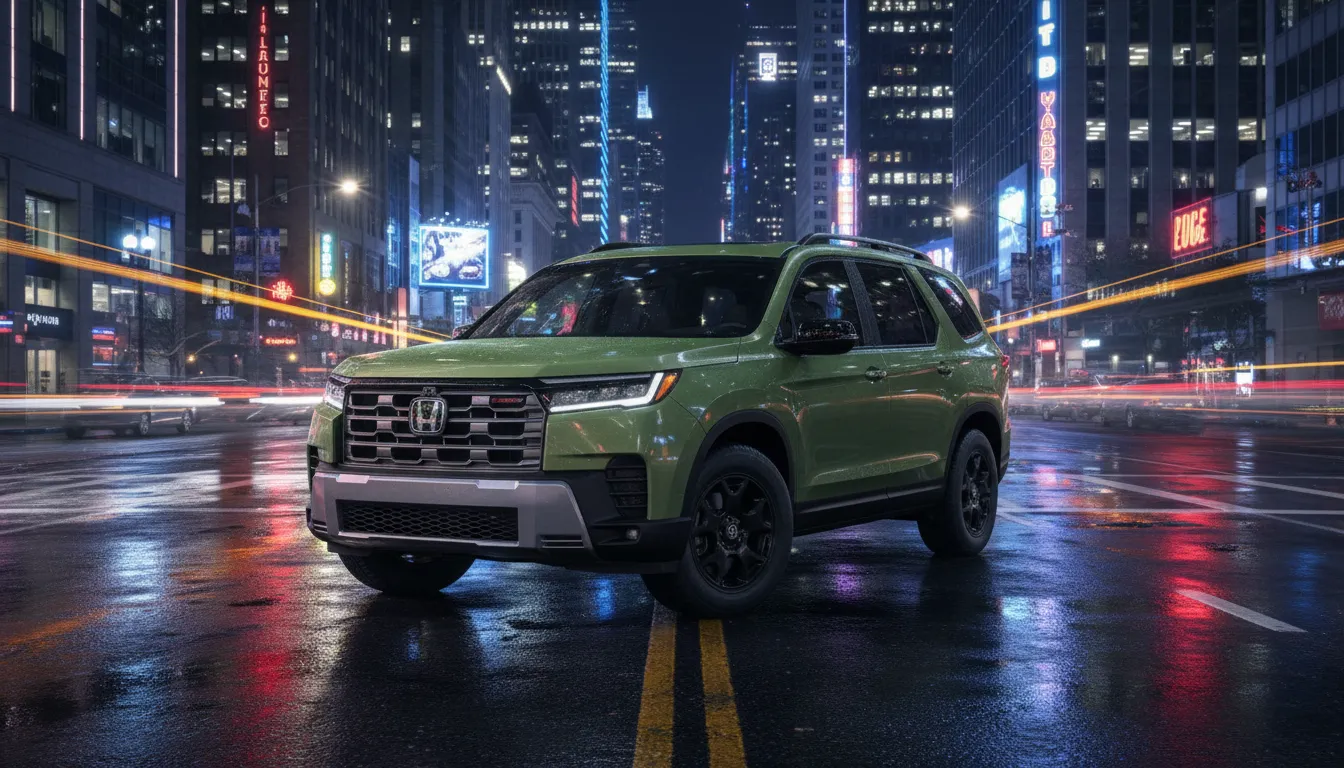
The Honda Pilot is Honda's biggest three-row SUV, and the trim most families in Vaughan end up in is the Touring AWD. After watching buyers cycle through the Pilot lineup this year, that is the trim I keep pointing at — it has the mechanical package every Pilot needs, the trim content most families actually use, and a monthly payment that lands in a sensible place. Here is the case, written out.
What the Pilot is and is not
The 2026 Pilot is a three-row, eight-seat, midsize SUV built on a light-truck architecture. It is Honda's biggest SUV, sitting above the Passport in size and below the Odyssey minivan in passenger packaging. Every 2026 Pilot runs a 3.5-litre V6 producing 285 horsepower at 6,100 rpm and 262 lb-ft of torque at 5,000 rpm, paired with a 10-speed automatic transmission. i-VTM4 all-wheel drive is standard across the Canadian lineup, with the torque-vectoring rear differential that improves cornering on dry pavement and traction in snow.
The Pilot is the SUV for families who have outgrown the CR-V's smaller third row but do not want to step down to a minivan. It tows up to 5,000 lb when properly equipped with the accessory tow package, which is more than enough for a small travel trailer, a bass boat, or a pair of side-by-sides on a flatbed. honda.ca rates the Pilot Touring at 12.7 L/100 km city, 9.4 highway, 11.2 combined on regular-grade fuel.
Why the Touring AWD is the right trim
The 2026 Pilot Canadian lineup runs through five AWD trims: Sport, EX-L, TrailSport, Touring, and the top-tier Black Edition. The Touring is the trim that splits the difference the right way for most Vaughan buyers — it has the powertrain, the all-wheel drive, and the equipment most families actually use, without the price premium of the top trim.
Specifically, the Touring gives you:
- The 3.5L V6 with 285 hp and 10-speed automatic — same as every Pilot trim, no compromises
- i-VTM4 AWD with torque-vectoring rear differential — standard across the lineup, but the Touring is the trim where the package feels most appropriate
- Leather-trimmed seating throughout, with the heated and ventilated front seats
- The heated steering wheel, heated second-row seats (outboard positions), and tri-zone automatic climate control
- The 9-inch touchscreen with wireless Apple CarPlay and Android Auto, the 10.2-inch digital instrument cluster, and the 12-speaker Bose premium audio system
- The hands-free power tailgate, the panoramic moonroof, and the LED headlights with auto high-beam
- 20-inch alloy wheels, roof rails, and the full Honda Sensing safety suite
What the Touring skips versus the top-tier trims is mostly styling — the Black Edition adds the gloss black 20-inch alloys, the black exterior trim pieces, the red ambient interior lighting, and a few exclusive two-tone paint options. Those look great on the brochure. They do not change how the Pilot drives, seats eight, or tows. For most Vaughan families, the Touring's content is more than enough.
 AI creative image
 AI creative image
How the Pilot compares to the Passport and the Odyssey
The Pilot's natural cross-shop is the Honda Passport (which is a two-row midsize SUV) and the Honda Odyssey (which is a minivan). The right choice depends on how often you actually use the third row:
- If you need a real third row and you do not want a minivan, the Pilot is the right Honda. The third row fits two adults on a long drive or three kids in car seats, and the cargo room behind it is generous.
- If you rarely use the third row and you want a more city-friendly footprint, the Passport TrailSport is the right Honda. Same V6, slightly smaller, more ground clearance, more off-road visual.
- If you want the most passenger and cargo space and the sliding doors and the Magic Slide second row, the Odyssey Sport-L is the right Honda. The trade-off is the minivan profile.
The Pilot sits in the middle on size and the top of the SUV lineup on capability. It is the right answer for the buyer who needs the third row sometimes but not every day, and who wants SUV styling over minivan styling.
It is built in the United States, not Canada
Confirm Pilot build origin on honda.ca or the window sticker for the specific unit. Alliston builds Civic and CR-V only. For buyers who want a Honda built in Canada, Civic and CR-V are the qualifying nameplates.
What it costs to run
The Pilot's combined fuel-economy number of 11.2 L/100 km is meaningfully higher than the CR-V Hybrid (6.4 L/100 km combined) and roughly comparable to the Odyssey (10.6 L/100 km combined). Across 20,000 km a year at current Ontario fuel prices, the Pilot's annual fuel cost lands roughly $1,000 a year higher than the CR-V Hybrid. For a Vaughan buyer doing significant commuter mileage, the math matters. For a buyer using the Pilot as a family hauler with shorter hops, the fuel cost is part of what you are paying for the size and the V6.
Maintenance costs on the Pilot are reasonable for the segment. The 3.5L V6 is a long-proven engine with no major reliability issues, the 10-speed automatic is well-regarded, and the i-VTM4 AWD system is mechanical and serviceable. Honda's standard warranty covers 3 years / 60,000 km comprehensive and 5 years / 100,000 km powertrain.
Three Vaughan buyers, three Honda three-rows
- Honda CR-V Hybrid: the family that uses two rows and wants the best fuel economy. Built in Alliston.
- Honda Pilot Touring AWD: the family that uses the third row sometimes and wants SUV styling. The right Pilot trim for most buyers.
- Honda Odyssey Sport-L: the family that uses the third row all the time and wants the most passenger and cargo space. Minivan profile, no apology.
The bottom line
The 2026 Honda Pilot Touring AWD is not the smallest SUV Honda sells, and it is not the most efficient. It is the SUV most Vaughan families who actually need a third row should drive home. It has the V6, the AWD, the eight seats, the 5,000 lb tow rating when equipped, and the trim content most families actually use — at a price that lands below the top-tier Black Edition without sacrificing the equipment that matters. If you are shopping three-row family SUVs this summer, drive a Pilot Touring AWD before you decide on anything else. Henry can set up that test drive on the same afternoon, and you can bring the family to check the third-row seating in the parking lot.
Frequently asked questions
How much horsepower does the 2026 Honda Pilot have?
Every 2026 Pilot runs a 3.5-litre V6 producing 285 horsepower at 6,100 rpm and 262 lb-ft of torque at 5,000 rpm, paired with a 10-speed automatic transmission. i-VTM4 all-wheel drive with torque-vectoring rear differential is standard across the Canadian lineup.
How many seats does the 2026 Honda Pilot have?
The 2026 Pilot seats eight with the standard second-row bench. The middle row slides and reclines for third-row access, and the third row folds flat for expanded cargo. Behind the third row, the Pilot offers competitive cargo volume for the three-row midsize SUV class.
How much can the 2026 Honda Pilot tow?
The Pilot is rated to tow up to 5,000 lb when properly equipped with the accessory tow package. That covers most small travel trailers, bass boats, and a pair of side-by-sides on a flatbed. Without the tow package, the tow rating is lower.
Where is the 2026 Honda Pilot built?
Confirm Pilot build origin on honda.ca or the window sticker for the specific unit. Alliston builds Civic (Plant 1) and CR-V (Plant 2) only.
What is the difference between the Pilot Touring and the Pilot Black Edition?
The Touring is the trim most Vaughan families end up in, with leather seating, heated and ventilated front seats, the heated second-row seats, the 12-speaker Bose audio, the panoramic moonroof, the hands-free power tailgate, and the full Honda Sensing suite. The Black Edition adds the gloss black 20-inch alloys, black exterior trim pieces, red ambient interior lighting, and exclusive two-tone paint options. Mechanically the two trims are identical.
Want to drive a 2026 Pilot Touring AWD with the family?
Henry can set up a same-day test drive. Bring car seats — we'll set up the second-row access in the parking lot so you can see the third row in real life.
Powertrain, fuel-economy, and Canadian MSRP figures sourced from honda.ca/en/pilot (2026 model year). Tow rating per honda.ca/en/pilot/specs with the accessory tow package. Build origin: confirm on honda.ca or the window sticker for the specific unit — Pilot is not on the HCM Plant 1 or Plant 2 product lists Fuel-economy comparisons (CR-V Hybrid, Odyssey) per honda.ca and HONDA_CANADA_FACTS.json reference on this site.
Ask Henry a question
Not ready to book anything? Just ask. Henry Chen answers every message himself — usually within a couple of hours during business hours. No call list, no pressure, and no obligation to buy anything.