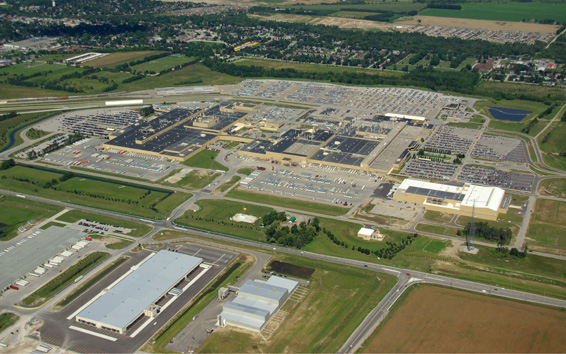
Photo: Honda Global. Aerial view of Honda of Canada Manufacturing in Alliston, Ontario.
When most people think about Civic and CR-V, they think about fuel economy, reliability, resale value, and day-to-day ownership cost. Fair enough. That's the buyer-facing story. The manufacturing story behind those vehicles matters too, especially if you care about long-term confidence and not just the test drive.
A large share of the Civic and CR-V sold here are built in Alliston, Ontario at Honda of Canada Manufacturing. That operation isn't a small regional plant. It's one of Honda's serious North American production centers, with two vehicle plants and an engine plant working inside the same system.
The simple math: Alliston's annual vehicle capacity is about 400,000 units. Spread across a full calendar year, that's roughly 1,096 vehicles a day, or the equivalent of about 46 vehicles an hour. Real production never runs that neatly, but the scale is the point.
Read the speed number correctly
Factories don't build cars in a perfect straight line 24 hours a day with zero interruptions. Output depends on shifts, model mix, parts flow, maintenance windows, quality checks, and market demand. So I wouldn't use the 46-an-hour figure as a literal line-speed claim.
I'd use it the way buyers actually should: as a way to understand that Honda is building Civic and CR-V as high-volume mainstream products with a repeatable process behind them, not as niche experiments that happen to be on a lot this month.
Why that matters more than factory bragging rights
Any factory can try to build fast. The harder job is building fast while keeping the result consistent. That's where Honda's process matters. Before a Civic or CR-V gets to a customer, it moves through stamping, welding, paint, sub-assembly, final assembly, testing, and quality assurance. The goal isn't just output. The goal is output with discipline.
That's part of why the market keeps trusting these two nameplates. Buyers aren't only paying for a badge. They're paying for a manufacturing system that has been running long enough for the process to feel proven.
The Civic and CR-V buyer angle
The Civic has been built in Alliston since 1986, and CR-V production there started in 2012. Those dates matter because these vehicles aren’t new to the plant, and the plant isn’t new to them.
For a Civic buyer, that history shows up as something pretty simple: a compact car with a long local manufacturing track record, strong familiarity in the service network, and a reputation the market already understands. For a CR-V buyer, it reinforces why the vehicle feels so embedded in Ontario family-car logic: it's roomy, visible, efficient enough, easy to live with, and built inside the same Ontario system that Honda has been refining for decades.
Why a Vaughan or Aurora shopper should care
If you live in Vaughan, Aurora, Richmond Hill, or Newmarket, "built in Alliston" isn't just a patriotic marketing line. Local high-volume production usually helps support steadier inventory, easier parts flow, and a stronger sense that Honda is invested in keeping Civic and CR-V support deep in Ontario. That doesn't guarantee instant availability of every trim or colour. It does help explain why these models feel so established in this market.
It also helps explain trust. When people ask why Civic and CR-V keep holding their place in Canada, the answer isn't only that the products are good. It's that Honda has been building them at scale, through a stable process, for a long time. The market tends to trust what it has seen repeated successfully.
Final thought
So yes, the headline number is impressive: around 400,000 vehicles a year out of Alliston capacity. But the more important message isn't speed for its own sake. It's that Honda has the scale to build a lot of Civic and CR-V units and the discipline to build them through a mature Ontario process buyers already understand.
If you're considering either model, you aren't just looking at another car on a lot. You're looking at two products that sit right in the middle of Honda's Canadian manufacturing identity.
Common questions
How many vehicles can Honda's Alliston factory build in a year?
About 400,000 at annual capacity. Spread across a full calendar year, that's roughly 1,096 vehicles a day or the equivalent of about 46 vehicles an hour, although real production depends on shifts, maintenance, parts flow, and model mix.
Are the Honda Civic and CR-V sold here really built in Ontario?
Yes. The Civic Sedan and CR-V are built in Alliston, Ontario. Civic production there dates back to 1986, and CR-V production in Alliston began in 2012.
Does a high-volume factory automatically mean lower quality?
No. The better takeaway is that Honda isn't treating Civic and CR-V like niche experiments. These are high-volume vehicles built through a mature, repeatable process with trained teams and standardized quality control behind them.
Why should a Vaughan or Aurora buyer care about Alliston production?
Because local high-volume production usually supports steadier supply, deep Ontario parts support, and more confidence in long-term ownership. It's one reason Civic and CR-V feel so established in the Canadian market.
Trying to decide whether Civic or CR-V fits your life better?
I can walk you through the buyer side of it: size, payment, commute fit, trade-in impact, and which trims are actually worth your time.
Ask Henry a question
Not ready to book anything? Just ask. Henry Chen answers every message himself — usually within a couple of hours during business hours. No call list, no pressure, and no obligation to buy anything.