Every spring, half the conversations on my desk shift from "what's my commute car?" to "what's my cottage car?" — usually the same week the long-range forecast turns. The right Vaughan-to-cottage road trip car isn't the biggest, the most powerful, or the one with the longest spec sheet. It's the one that fits the trip you actually take, the people you actually carry, and the budget you actually live with the rest of the year.
I've watched Vaughan families overspend on a three-row SUV they only fill once a year. I've watched commuters undersize and end up renting twice a season. The right answer almost always comes from honest answers to four questions: how many bodies, how much gear, how often, and what's the rest of the week look like.
Start with the trip, not the car
The cottage drive from Vaughan is rarely just one drive. It's a Friday-evening 400-North escape with everyone tired, a Sunday-night queue back into the city, and at least one mid-week run when something breaks at the cottage. Add an unplanned IKEA trip, two grocery hauls, and the school run on either end. The car has to live the whole week — not just the weekend.
That's the rule I keep repeating to Vaughan customers: buy the car you'll use Monday through Friday, not the car you wish you had on Saturday. A Honda that's right for the cottage trip but punishing in your daily life is the wrong Honda.
The honest Honda shortlist for the Vaughan-to-cottage road trip
Honda CR-V (gas or hybrid)
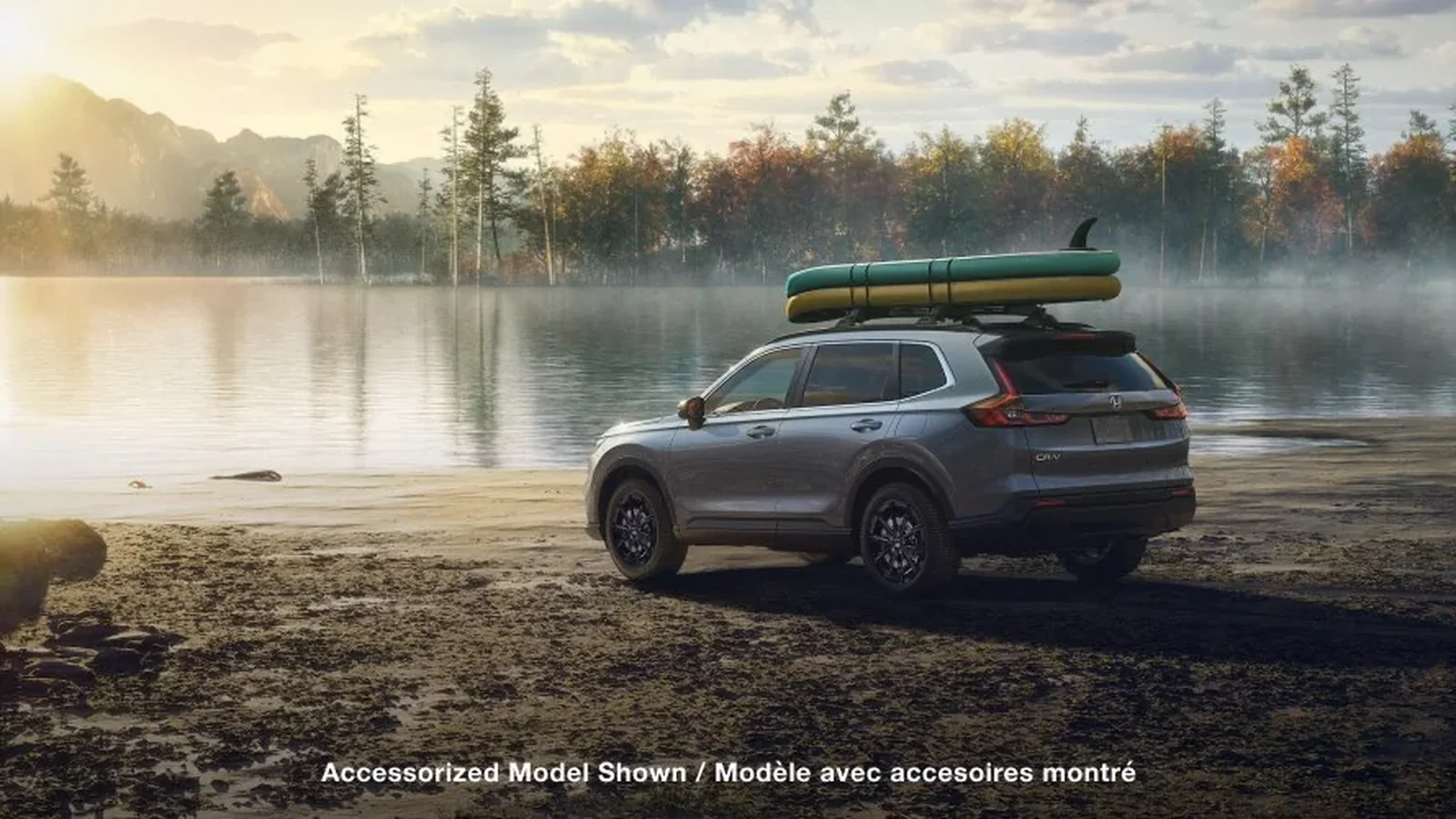
The CR-V is the Vaughan default for a reason. The current generation is roughly 4,695 mm long — about 10 cm longer than the previous one — with seats-folded cargo of 2,166 L (compared with 1,977 L on the Toyota RAV4 you'll cross-shop). For a couple or a small family of three with a dog, a couple of bikes on a hitch rack, and a long weekend's worth of soft luggage, the CR-V swallows the trip without complaint.
The CR-V Hybrid is the version I quietly steer most cottage-going Vaughan families toward. Its Atkinson-cycle engine reaches an industry-leading thermal efficiency around 41% — most internal-combustion engines sit near 20%. Translation: real fuel-cost relief on a 3-hour highway run, plus the same relief on the rest of the week.
Honda Pilot
The Pilot is what I recommend when "five people plus stuff" is the honest count. Honda still gives the Pilot a V6 — they did not chase the small-turbo trend on their larger vehicles, and on a Vaughan-to-cottage drive that V6 shows its value at every Highway 400 merge and every two-lane pass north of Barrie. Maple and Kleinburg families who tow a small trailer or carry a lot of weight find the Pilot's calm under load is the difference between an enjoyable trip and a tense one.
One real-world note: at just over 5 m long (5,083 mm), the Pilot needs a careful look at your Vaughan garage depth before you commit. Measure once before you buy.
Honda Odyssey
If your honest count is six or seven people — kids, in-laws, a family friend joining for the weekend — the Odyssey beats every SUV in the Honda lineup for usable interior space. People in Vaughan dismiss the minivan because it's a minivan; the people who actually buy one stop apologizing about three weekends later. For a Woodbridge family with regular cottage rotation, an Odyssey is often quietly the smartest choice.
Honda Passport
The Passport sits between the CR-V and the Pilot. At about 4,864 mm long and 2,019 mm wide, it has the road presence of a larger SUV without the third row you may not need. A common Vaughan use case: two adults plus dogs and ski racks, or two adults plus a teen and serious gear. Passport buyers are rarely first-time SUV shoppers — they tend to know exactly what they want.
Honda Prologue
The Prologue (Honda's full electric SUV) is a real option for Vaughan-to-cottage trips if your cottage has Level 2 charging or your loop is short. Plan for about 30% range loss in winter on average, sometimes 40–50% in the hardest cold snaps — heat actually ages a battery faster than cold does, but cold drives more battery use. If your cottage is on grid and you can wake up to a full battery, the Prologue is excellent. If it isn't, this is not the trip car.
What people overweight, and what they underweight
What Vaughan customers tend to overweight when shopping a cottage car: horsepower, third-row presence, and roof-rail visuals. What they tend to underweight: ride quality on rough side roads, real fuel cost across a year, garage fit, and how the car feels in Highway 400 stop-and-go on a Friday evening.
A good Vaughan-to-cottage road trip car is one you don't have to think about. You load it, you drive, you arrive, you forget what brand it is for two days. That's the goal.
Honda Sensing is standard across the lineup, and the feature most cottage-going customers end up valuing most isn't the spec-sheet hero — it isn't lane-keep or sign reading. It's the adaptive cruise control with low-speed-follow on the way home Sunday night when traffic stacks up around the 400/407.
Lease vs finance for a cottage Honda
Two patterns I see in Vaughan customers buying a cottage-friendly Honda:
- Lease if you change vehicles every 3–5 years, want the car under warranty for the whole time you own it, and want the option to right-size at lease end if your family changes shape.
- Finance if you keep cars 7–10 years, drive heavy annual kilometres (cottage families often do), and want clear ownership at the end. A 20–30% down payment on a sensible 5–7 year term keeps you out of the upside-down trap.
The right structure beats the lowest monthly payment. That's true for daily commuters and it's especially true for cottage families, because the car will see hard kilometres for years.
Before the first cottage drive of the season
- Check tire pressure cold, before the drive. Cottage roads are rarely the place to discover a slow leak.
- Top up windshield washer fluid for spring bug season — bring a spare jug.
- Run a Honda recall lookup for your VIN. Recalls are fixed for free at Maple Honda; the lookup takes 30 seconds.
- Read the Maintenance Minder on the dashboard, not the calendar. Vaughan stop-and-go service intervals come up faster than pure-highway driving — let the car tell you when, not the spreadsheet.
Frequently asked, Vaughan edition
Which Honda is the best Vaughan-to-cottage road trip car for a family of five?
For a family of five with bikes, coolers, and a weekend's worth of luggage, the Honda Pilot or Honda Odyssey both handle the drive easily. The Pilot's V6 makes overtaking calm; the Odyssey beats every SUV for usable interior space.
Is the Honda CR-V Hybrid a good cottage car from Vaughan?
Yes — for a couple or a small family. The CR-V Hybrid's Atkinson-cycle engine is one of the most fuel-efficient gas powertrains Honda makes, which matters on a 3-hour highway run plus weekend errands.
What about a Honda Prologue for a Vaughan-to-cottage drive?
It works if your cottage has charging or you're doing a shorter loop. Plan for around 30% winter range loss on average, more in extreme cold. If you can wake up to a full battery, it's an excellent road-trip car.
What should I check before the first cottage drive of the season?
Tires (pressure and tread), windshield washer fluid, a check of any active recalls, and the Maintenance Minder reading. Vaughan stop-and-go service intervals come up faster than highway-only driving.
Want help with a Vaughan-to-cottage road trip car from a real human?
Henry Chen at Maple Honda will walk you through the numbers in plain English — no pressure, no scripted pitch.
Ask Henry a question
Not ready to book anything? Just ask. Henry Chen answers every message himself — usually within a couple of hours during business hours. No call list, no pressure, and no obligation to buy anything.